Table of Contents[Hide]
- 1. Why fit is the only rule that truly matters
- 2. The fundamental rules of how to wear a suit jacket
- 3. Shirt, collar, and cuff rules that complete the look
- 4. Trouser rules: Break, length, and the savile row fold
- 5. Accessories: The grammar of a well-dressed man
- 6. How to wear a suit by occasion a complete reference guide
- 7. Choosing suit colors and shades a guide for men
- 8. Tailoring styles: British, italian, and american which suits your lifestyle?
- 9. How to wear a suit for your body type
- 10. How to wear a suit in different climates and seasons
- 11. Suit trends to know in 2025–2026
- 12. Why a custom suit makes how to wear a suit easier
- 13. Frequently asked questions about how to wear a suit
- Conclusion
Wearing a suit is easy. Wearing one well is a different skill entirely. Whether you are stepping into a boardroom in London, attending a summer wedding in Sydney, navigating a black-tie gala in New York, or simply dressing to impress for a milestone dinner, the way you wear a suit tells a story about you before you say a word. A well-chosen, well-fitted suit commands instant respect. A poorly worn one regardless of the price tag does the opposite. This guide covers every angle of the topic: how a suit jacket, shirt, and trousers should fit; the non-negotiable rules of buttoning and accessories; how to match suit colors to your skin tone, occasion, and climate; how to dress a suit to your body type; and what the best suit trends of 2025 and 2026 look like. Whether you are broad-shouldered, lean and tall, or navigating a generous midsection, there is a strategy that works for you.
By the end of this guide, you will know not just the rules, but the reasoning behind them so you can dress with genuine confidence no matter the occasion.
1. Why fit is the only rule that truly matters
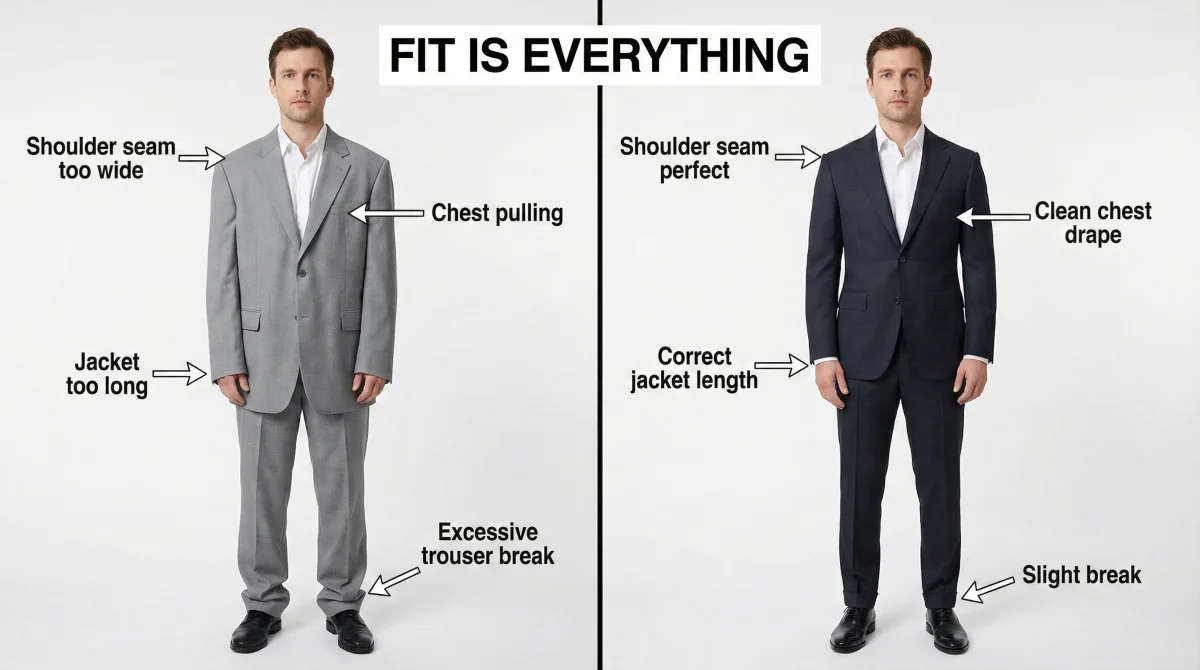
Before any discussion of buttons, colors, or accessories, fit must come first. A moderately priced suit that fits the body perfectly will always look more authoritative than an expensive one that does not. This is the single most important principle in learning how to wear a suit.
A well-fitted suit does three things:
-
It creates a clean shoulder line that frames the body with structure and authority.
-
It shapes the torso, providing visual definition between the chest and the waist.
-
It falls cleanly at the trouser hem, allowing shoes and footwear to anchor the look.
1.1 The three zones of fit
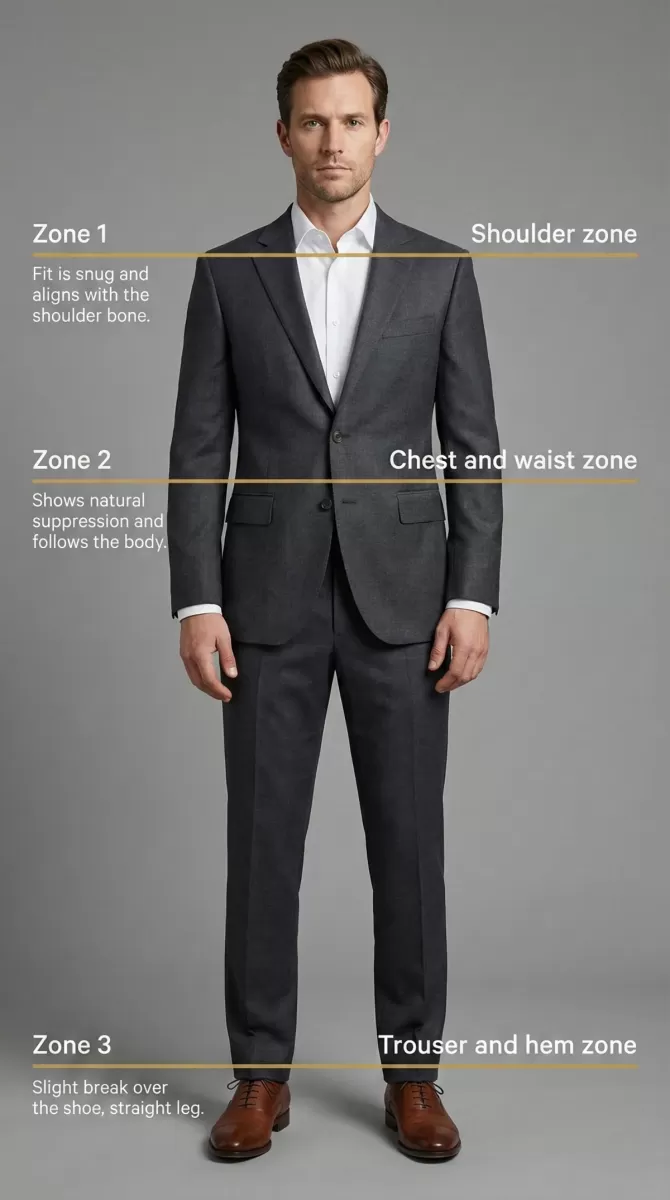
Every suit fit can be assessed through three zones:
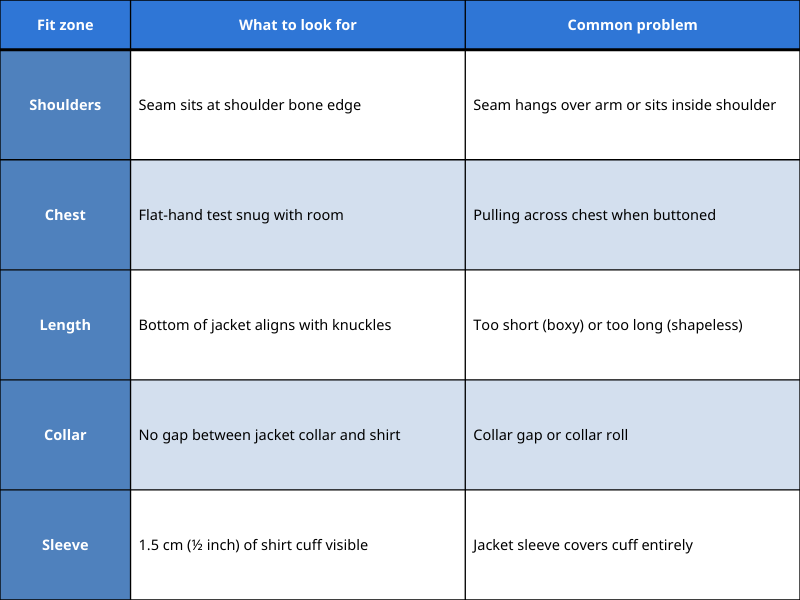
- Zone 1 The shoulder: The shoulder seam must sit exactly at the edge of the shoulder bone. Shoulders that hang over the arm or sit too close to the neck are the hardest fit issue to fix with alterations. Getting the shoulders right is non-negotiable.
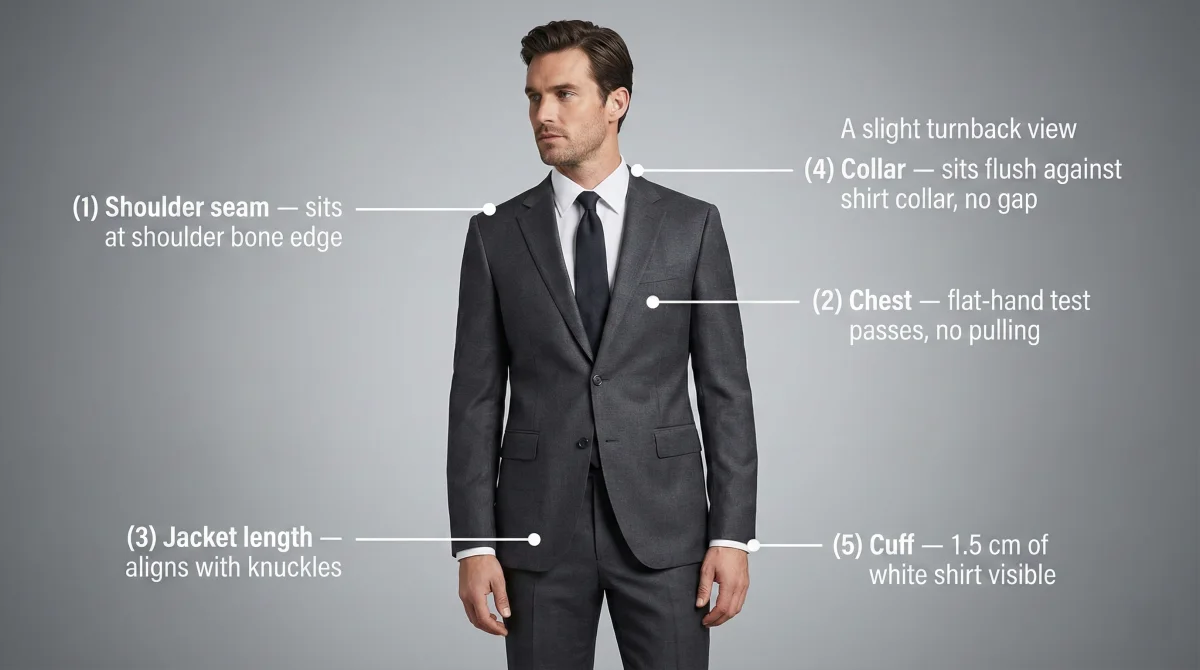
- Zone 2 The chest and waist: There should be no pulling across the chest when the jacket is buttoned. Slip a flat hand between your chest and the buttoned jacket it should feel snug with a small amount of room to breathe.
- Zone 3 The trouser and hem: Trousers should sit at the natural waist (or hip, depending on style) and fall cleanly to the shoe with the correct amount of break (covered in detail in Section 4).
1.2 Ready-to-wear vs custom the fit gap
Research shows that approximately 70% of men who purchase ready-to-wear suits require significant alterations. The shoulders and back collar are almost impossible to fix after manufacturing, meaning any ready-to-wear suit that does not fit perfectly in these areas is fundamentally flawed before a single alteration takes place.
Custom and made-to-measure tailoring eliminates this problem by constructing the garment around your actual measurements from the start. Rather than purchasing a garment then attempting to correct it, a custom suit begins where alterations cannot reach.
For a deeper breakdown of suit types, constructions, and fits, read the complete guide to types of suits for men on the Dunnio Tailor blog.
Explore custom suits at Dunnio Tailor
2. The fundamental rules of how to wear a suit jacket
2.1 The bottom button rule and why it exists
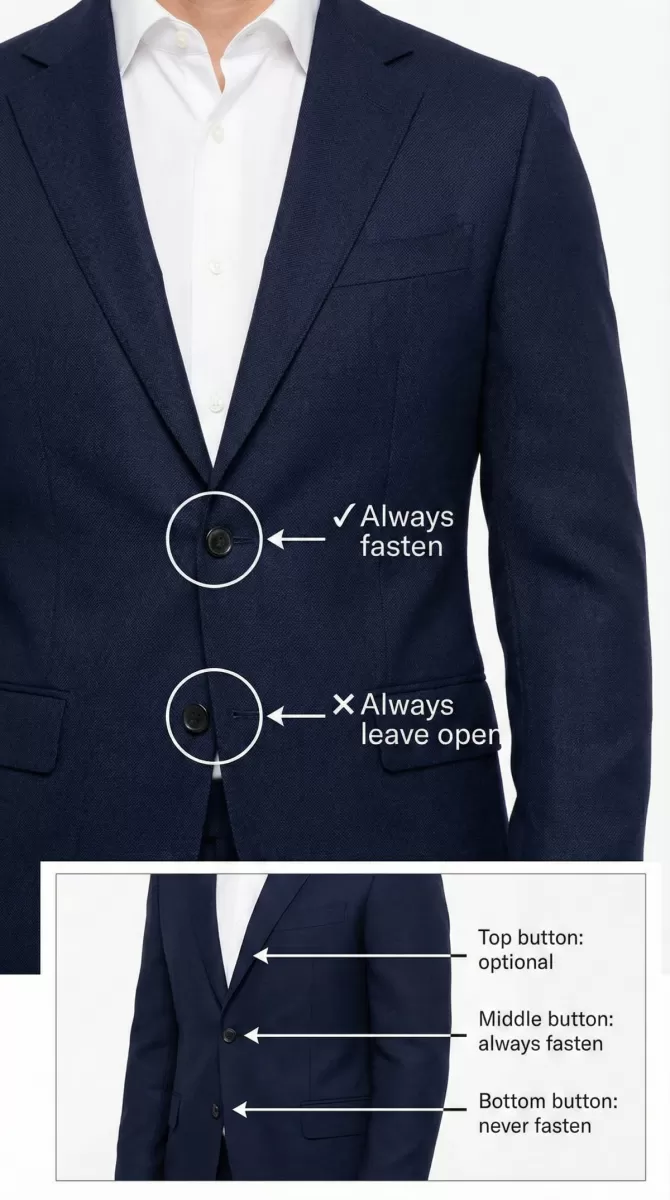
One of the most visible errors in men's dressing is leaving the bottom button of a suit jacket fastened. This rule applies universally, regardless of the suit's price or quality.
For a two-button jacket:
-
Top button always fastened when standing.
-
Bottom button always left open, without exception.
For a three-button jacket:
-
Top button optional (usually left open).
-
Middle button always fastened.
-
Bottom button never fastened.
When seated: All jacket buttons should be undone. This prevents the jacket from bunching at the collar and protects the buttons from stress.
The reason this rule exists is structural: modern suit jackets are cut to drape naturally from the waist. Fastening the bottom button creates tension across the hips, pulls the fabric tightly, and distorts the clean line that the jacket was designed to project.
For a three-piece suit or waistcoat: The bottom button of the waistcoat (vest) also remains undone at all times a tradition with roots in the reign of King Edward VII.
2.2 Jacket fit checklist
2.3 Single-breasted vs double-breasted
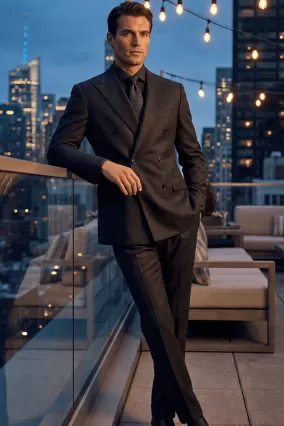
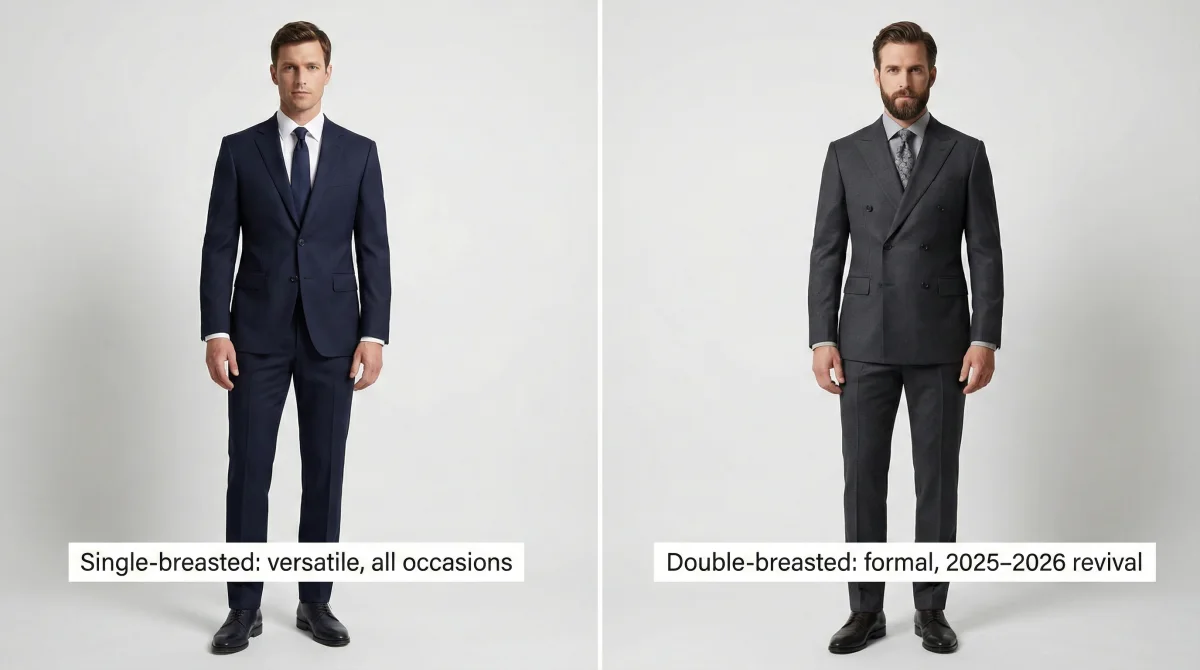
Single-breasted jackets are the versatile standard appropriate for every occasion from business to weddings to cocktail events. Double-breasted jackets are more formal and fashion-forward, with all buttons typically fastened when standing. The double-breasted silhouette is seeing a strong revival in 2025 and 2026, particularly in mid-blue, charcoal, and earth-tone colourways.
For guidance on lapel styles notch vs peak and which suits which occasion, see the notch lapels vs peak lapels guide on the Dunnio Tailor blog.
3. Shirt, collar, and cuff rules that complete the look
The suit jacket is only half of the picture. The shirt underneath and how it interacts with the jacket determines much of the overall polish.
-
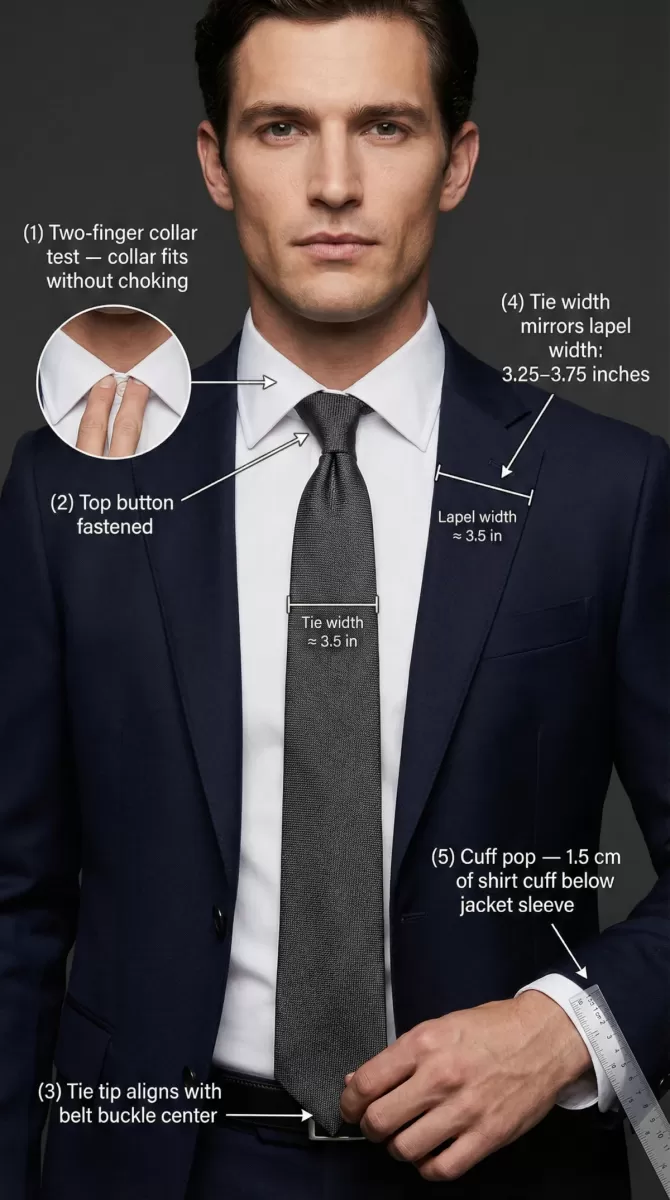
Collar fit: The shirt collar should allow two fingers to be inserted between the collar and the neck. A collar that chokes the neck looks uncomfortable and projects tension rather than confidence. Conversely, a collar that is too loose appears unkempt.
-
Top button: The top button of the dress shirt must always be fastened when wearing a tie. If the top button cannot be fastened comfortably, the shirt does not fit and should be replaced or custom-ordered.
-
Cuff exposure: The shirt sleeve cuff should extend approximately 1.5 cm (or about half an inch) below the jacket sleeve. This small detail sometimes called the "cuff pop" signals that both garments are the correct length and provides a visual frame for the hands.
-
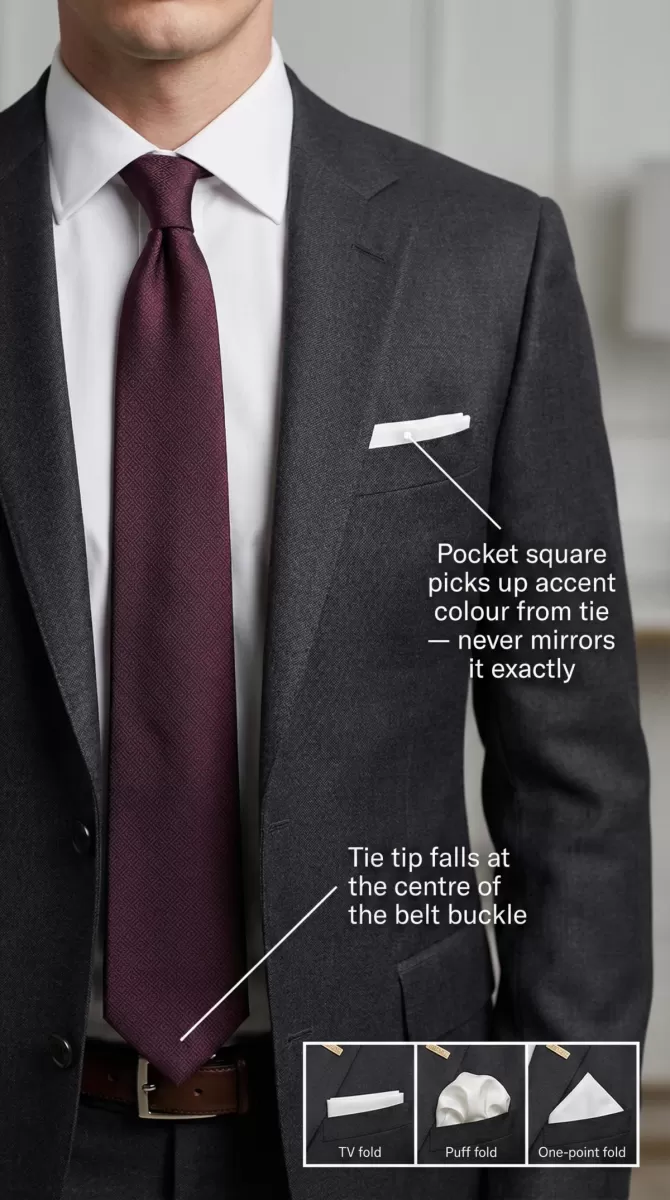
Tie length: The tip of the tie should fall at the center of the belt buckle. Not above it, not below it.
-
Tie color: The tie should always be in a darker shade than the shirt. A light grey shirt pairs with a charcoal or navy tie; a white shirt pairs with virtually any darker colour.
-
Tie and lapel width: In 2025 and 2026, the most balanced tie width is between 3.25 and 3.75 inches (approximately 8.2 to 9.5 cm). The tie width should broadly mirror the lapel width for a proportionate look.
-
Collar and jacket collar: The jacket collar must sit flush and flat against the back of the shirt collar. Any visible gap known as a collar gap indicates a fit issue in the jacket's back neckline and requires professional correction.
4. Trouser rules: Break, length, and the savile row fold
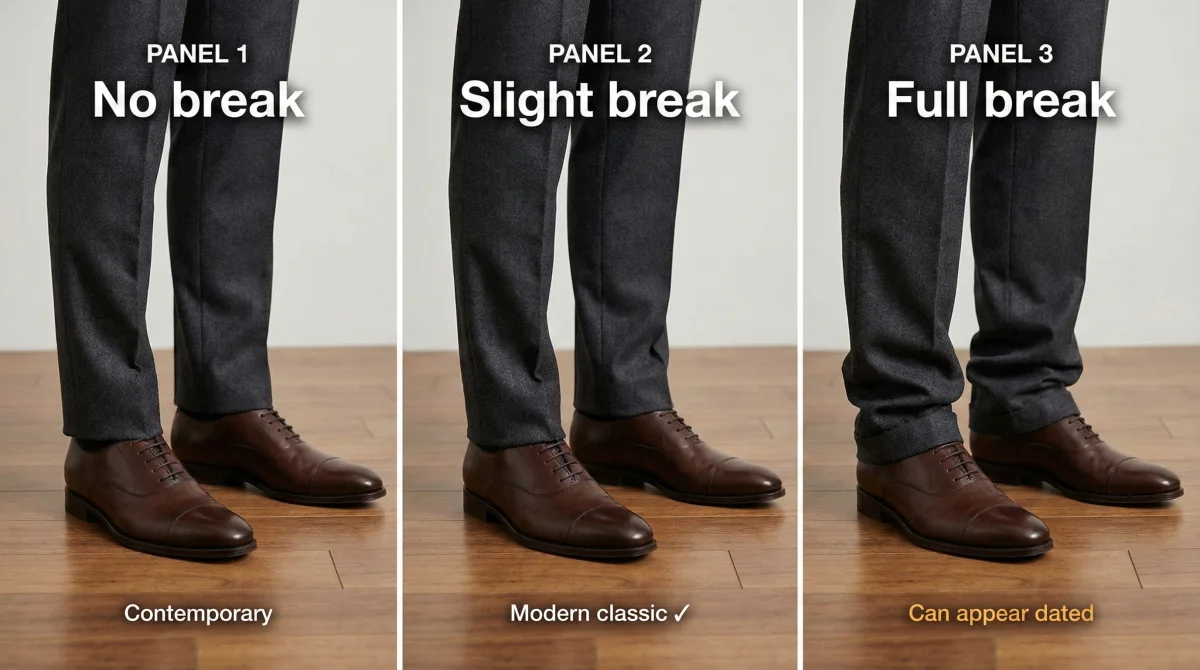
Trouser fit is defined largely by the "break" the amount of fabric that folds where the trouser leg meets the top of the shoe. This seemingly small detail dramatically affects the overall modernity and cleanliness of the look.
4.1 The three breaks explained
- No break: The trouser hem just skims the top of the shoe without any fabric fold. This creates the crispers, most contemporary line. Most associated with Italian tailoring and slim-fit trousers.
- Slight break: A single, subtle fold in the fabric. This is the modern professional standard versatile, neat, and appropriate for virtually any occasion.
- Full break: Multiple folds of fabric bunching at the ankle. This is the traditional American tailoring standard, which can appear dated and heavy unless the trousers are cut deliberately wide and the occasion is very conservative.
For most modern business and formal contexts, a slight break is the recommended default.
4.2 The savile row fold for storage
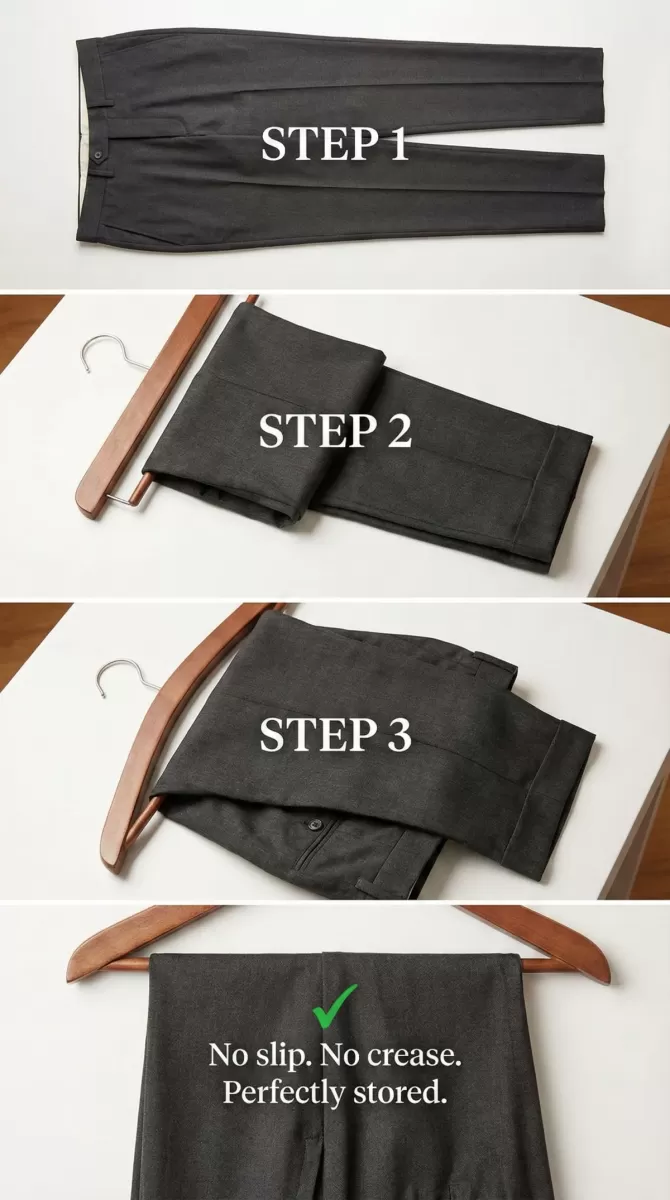
When hanging trousers on a hanger, use the "Savile Row fold" technique: lay both trouser legs flat, fold them over the hanger bar so the cuffs face down, and hook the hanger through the legs from the inside. This prevents the trousers from slipping and maintains the crease without creating unwanted fold lines.
4.3 Socks
Wear socks long enough that no bare skin is visible when seated and the trouser leg rises. For classic business or formal suits, opt for socks that match the trouser colour or a muted pattern that complements the overall palette. The modern sockless-with-a-loafer look is acceptable only for smart-casual or coastal leisure settings not in formal or corporate environments.
5. Accessories: The grammar of a well-dressed man
Accessories are the difference between a man who wears a suit and a man who is dressed. Each element follows a logic that, when understood, becomes second nature.
5.1 Belt and shoes the unbreakable color rule
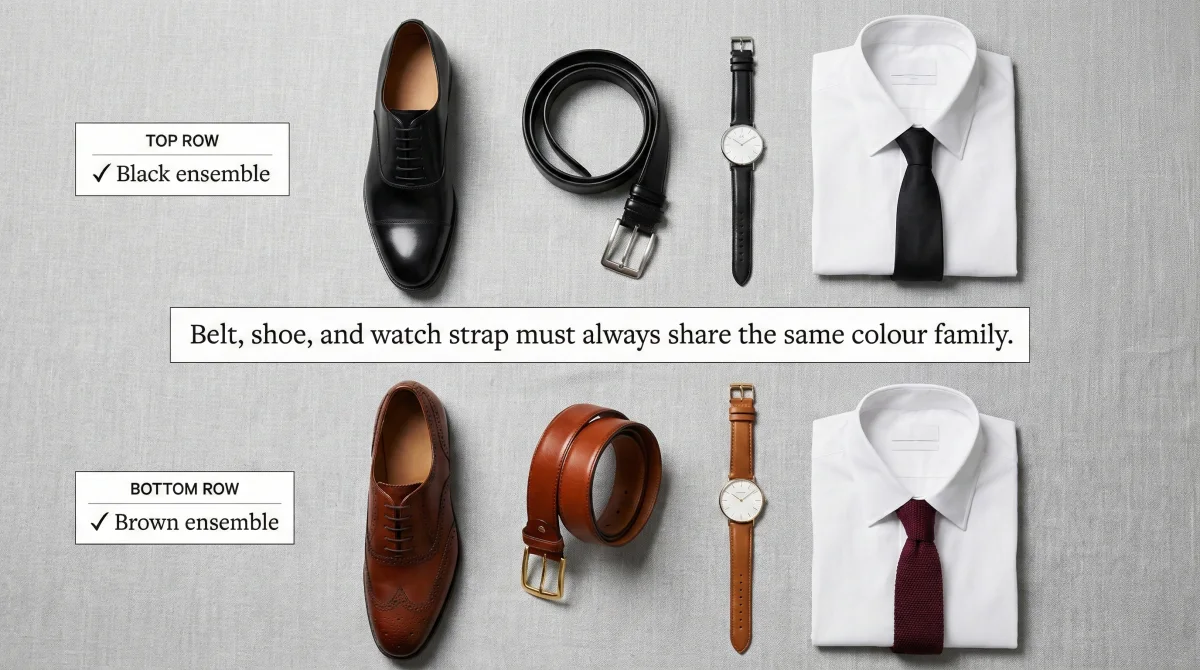
The color of the belt must always match the color of the shoes. No exceptions apply in professional or formal settings. The leather strap of a dress watch should also coordinate with the shoe and belt colour brown leather strap with brown shoes and a brown belt; black leather with black.
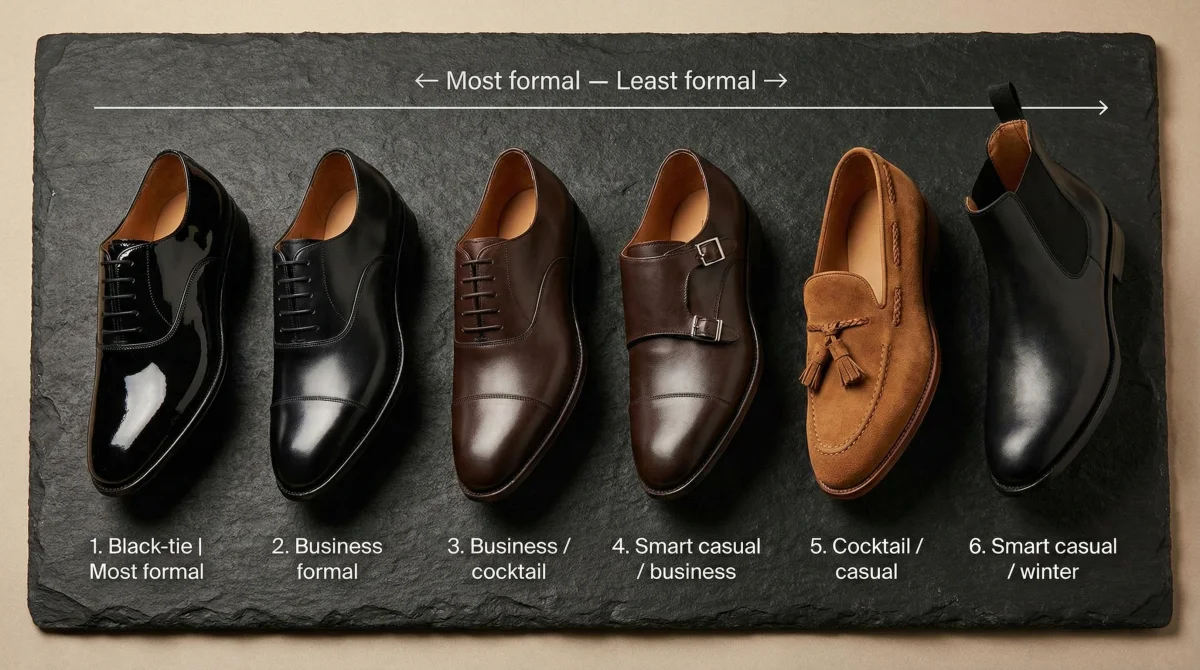
Oxfords feature closed lacing (eyelet tabs sewn underneath the vamp), creating the most formal and streamlined silhouette. Derbies feature open lacing and offer slightly more casual flexibility.

5.2 Tie and pocket square
The pocket square must never match the tie in pattern or fabric. This is one of the most commonly broken rules in men's dressing. The pocket square should pick up a secondary colour from the tie, shirt, or suit itself never mirror it.
Popular pocket square folds:
-
TV fold (flat fold): A clean horizontal line across the top of the breast pocket. Formal and architectural.
-
Puff fold: A soft, rounded top. More relaxed and creative, suited for social occasions.
-
One-point fold: A single triangular peak. A timeless business classic.
Bow ties are reserved for black-tie and white-tie events. Wearing a bow tie with a standard business or lounge suit looks eccentric rather than formal.
5.3 Watches, cufflinks, and lapel pins
A dress watch worn with a suit should be slim enough to slip comfortably under the shirt cuff. Metal bracelets are common, but a leather strap in a colour that mirrors the shoe and belt is the classically correct choice for formal settings.
Cufflinks are worn exclusively with French cuff (double cuff) shirts the ones that fold back and require a fastener rather than a button. Wearing cufflinks with a button-cuff shirt is not possible.
Lapel pins and collar bars are small details that add a layer of deliberate personal style but should remain understated. Save them for cocktail and social occasions rather than conservative corporate environments.
6. How to wear a suit by occasion a complete reference guide
The same suit worn to the wrong occasion signals either an unawareness of dress codes or a disregard for them. Both impressions are unwelcome. Here is a comprehensive occasion-to-outfit reference for how to wear a suit appropriately across the most common settings.
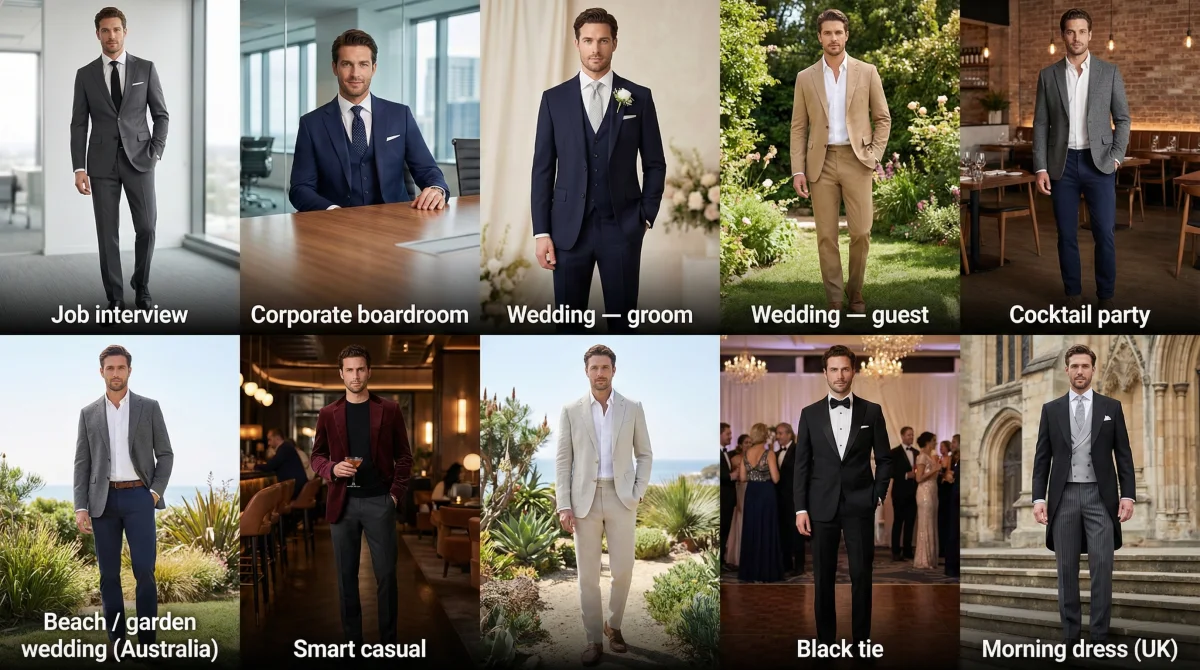

For a deep dive into cocktail dressing, including fabric selection and body-type guidance, read the complete guide to men's cocktail attire.
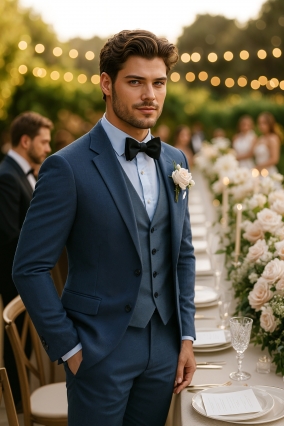
For wedding-specific guidance on how to build a groom's look from the ground up, see the ultimate guide to men's wedding suits.
Custom wedding suits designed and handcrafted

7. Choosing suit colors and shades a guide for men
Suit color is the first decision that communicates your intent before the jacket is even buttoned. Choosing the right color involves balancing occasion, formality, skin tone, and personal style.
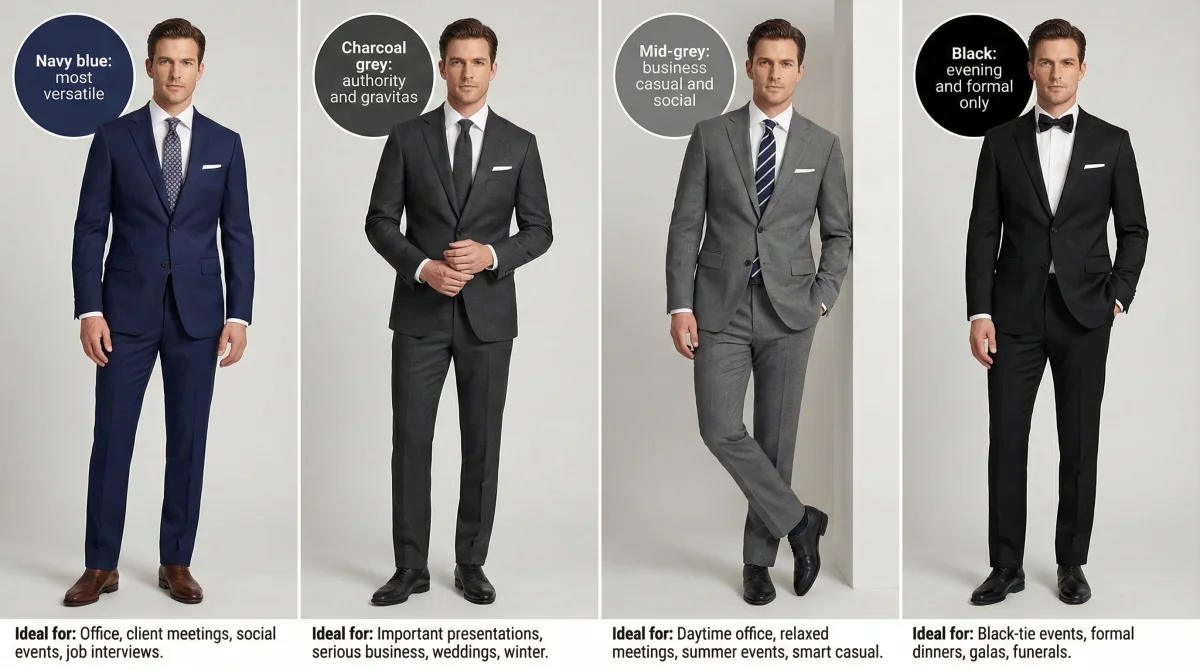
7.1 The foundational suit colors
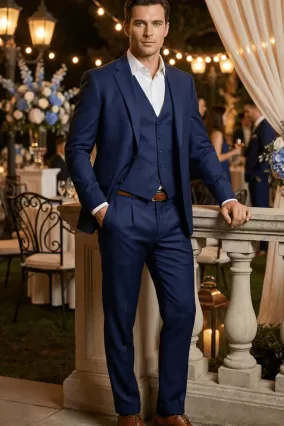
- Navy blue is the world's most versatile suit color. It works for business interviews, board meetings, weddings, and cocktail events. Navy complements most skin tones and pairs naturally with white, light blue, grey, and pink shirts. It is the first suit any man should own.
- Charcoal grey projects authority and gravitas. Marginally more formal than navy for daytime business settings, charcoal is the color of boardrooms and senior professional environments. It pairs with almost any shirt and tie combination.
- Mid-grey and light grey are softer alternatives to charcoal. Mid-grey is excellent for business casual and social events. Light grey works beautifully for warm-weather occasions and daytime weddings, particularly in lighter fabrics like linen or cotton.
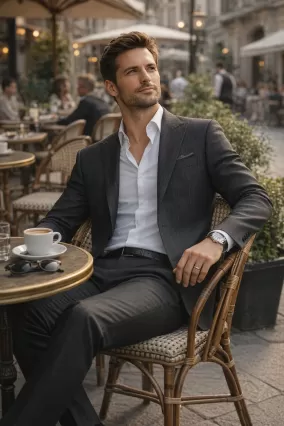
- Black is the most misused suit color. In daytime professional settings, a black suit reads as funereal or overly severe. Black's natural environment is evening events: formal dinners, black-tie occasions (when a tuxedo is not specified), and after-6 PM gatherings.
7.2 Beyond the basics expressive colorful suits for men
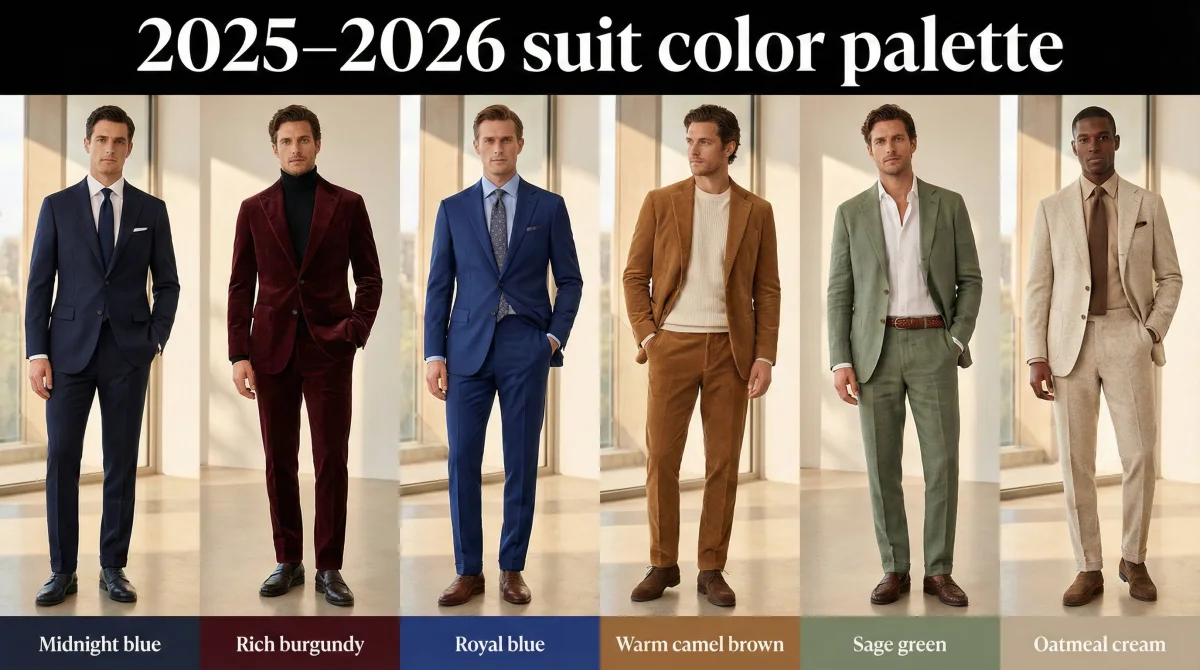
Once the foundational colors are established in a wardrobe, expanding into expressive territory opens up significant style possibilities:
-
Midnight blue: Darker and richer than standard navy, with a subtle sheen in low light. Often more flattering than black for evening events.
-
Burgundy: A bold statement for cocktail and social occasions. Best paired with a white or pale grey shirt and kept simple on accessories.
-
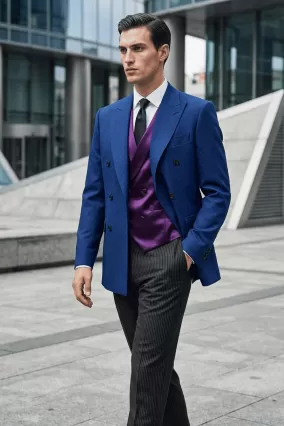
Mid-blue and royal blue: Modern and expressive. Works with lighter skin tones particularly well. Ideal for garden weddings and creative professional environments.
-
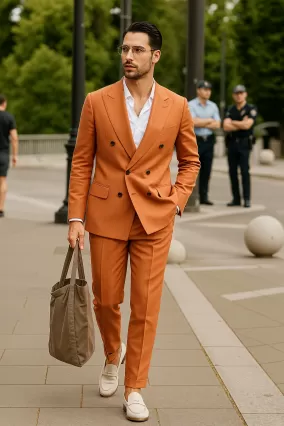
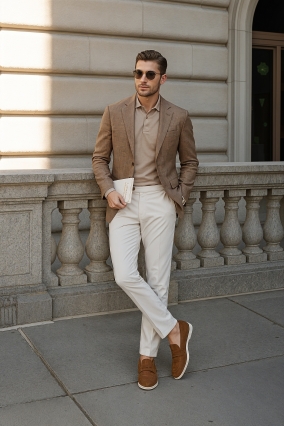
Earth tones tan, camel, warm brown, and olive green: The 2025–2026 "new neutrals" palette. These colors sit beautifully in both social and professional-creative environments and complement most skin tones.
-
Sage green and forest green: An emerging 2025–2026 choice that reads as simultaneously sophisticated and individual. Best in structured, mid-weight fabrics.
-
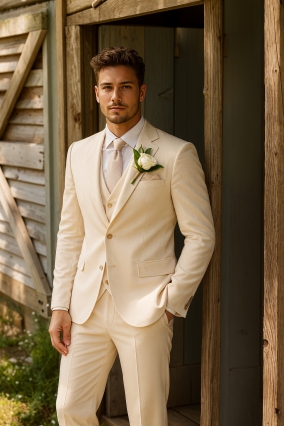
Beige and cream: For summer garden parties, beach weddings, and warm-weather resort events. Pair with a white shirt and tan loafers.
For a comprehensive breakdown of suit colors by occasion, skin tone, and region, read what suit color to choose: the complete men's guide on the Dunnio Tailor blog.
8. Tailoring styles: British, italian, and american which suits your lifestyle?
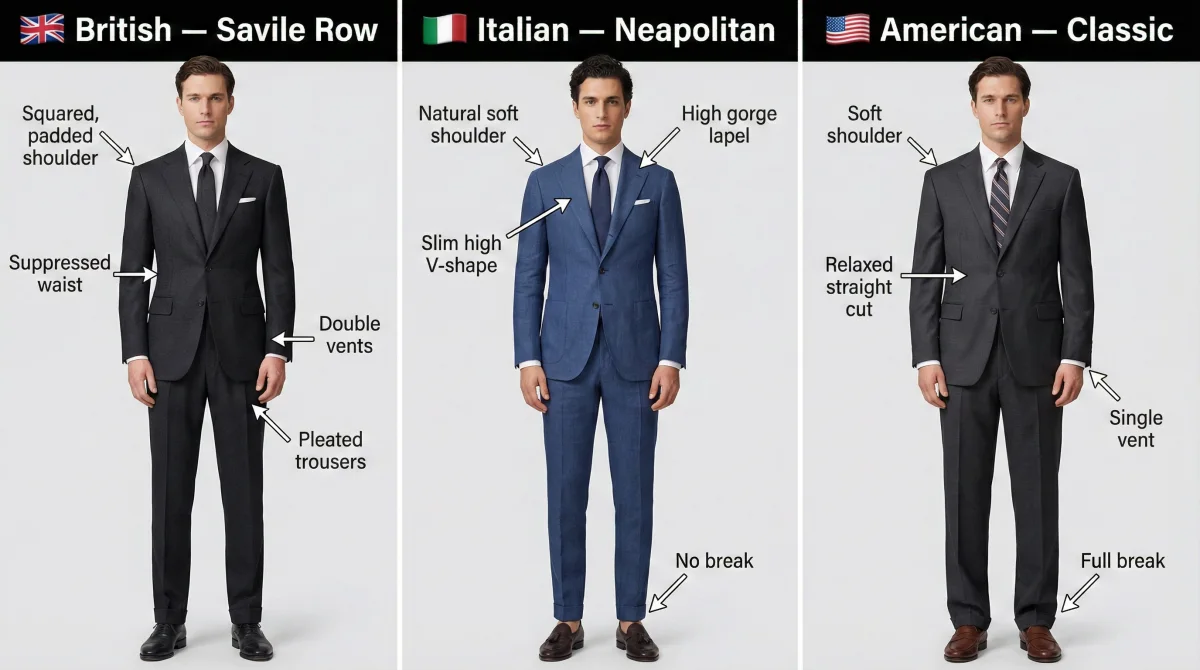
Understanding the three primary schools of tailoring allows you to choose a suit that aligns not just with your body, but with your cultural context, professional environment, and personal values.
- British tailoring (Savile Row tradition): defined by structure, shoulder padding, and a highly suppressed waist. Projects authority and formality. Best suited to conservative professional environments and men who prefer a strong silhouette.
- Italian tailoring (Neapolitan tradition): minimal padding, natural shoulder, slim through the chest and hip. Prioritises aesthetic elegance and personal expression. Excellent for social and creative settings but may read as too bold in very conservative environments.
- American tailoring (sack suit tradition): comfort-first, looser through the chest and hip, lower armholes. Practical and accessible. The modern American style has evolved considerably from the "shapeless" criticism of the past, now offering a relaxed professional standard.
In 2025 and 2026, the global trend is moving away from ultra-slim Italian-inspired fits toward a more generous, architectural silhouette that combines the comfort of American styling with the tailored refinement of British construction.

9. How to wear a suit for your body type
The ability to dress well regardless of build is one of the most practical and empowering aspects of understanding how to wear a suit. The rules of fit and proportion apply universally but the strategies differ.
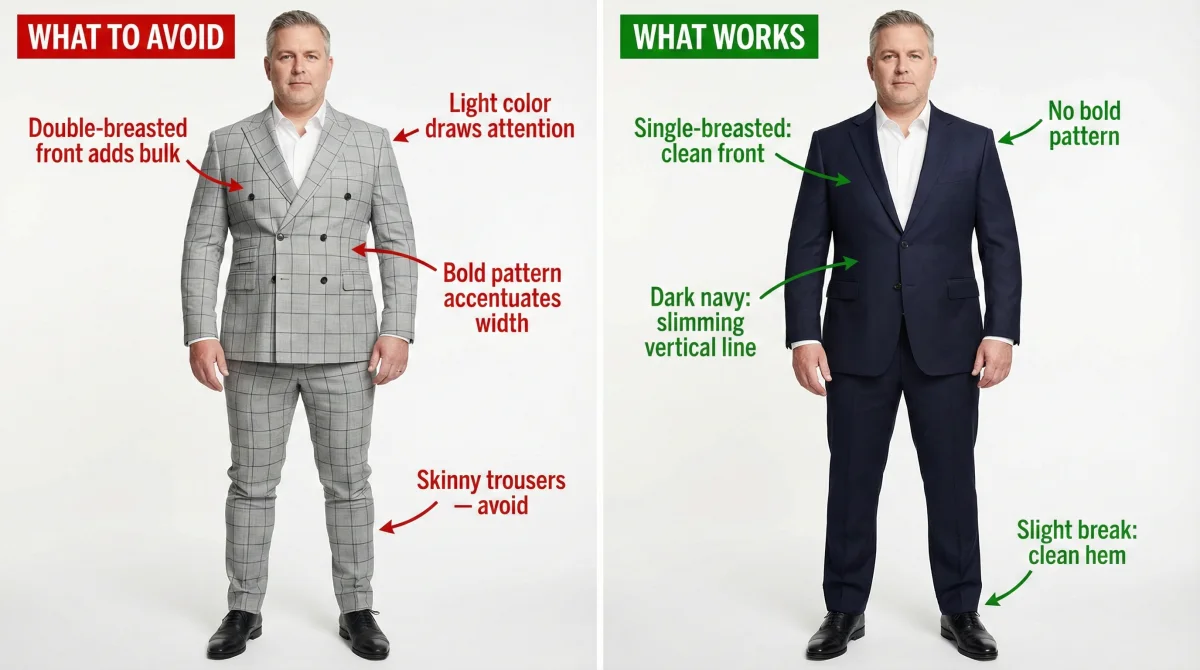
9.1 How to wear a suit for larger or bigger-bellied men
Larger men and those with a fuller midsection benefit most from a suit strategy that creates vertical lines and balanced proportions.
What works:
-
Single-breasted two-button jacket avoids the additional horizontal bulk of a double-breasted front.
-
Dark colors: charcoal grey and navy blue create a slimming vertical effect.
-
Minimal to no pattern avoid large windows or loud checks that accentuate width.
-
Slight trouser break clean lines at the hem prevent a heavy, blocky appearance.
-
A well-fitted jacket that suppresses gently at the waist without pulling this is where custom tailoring is most valuable.
What to avoid:
-
Double-breasted jackets (adds horizontal bulk at the chest).
-
Very slim or skinny trouser cuts (uncomfortable and unflattering at larger proportions).
-
Tight chest fit always leave the flat-hand test room in the jacket.
A custom suit is the most practical solution for larger builds because standard sizing blocks rarely account for the unique proportions of a fuller figure. Dunnio Tailor's made-to-measure process is designed precisely for situations where off-the-rack fails.
9.2 How to wear a suit for tall and slim or lean men
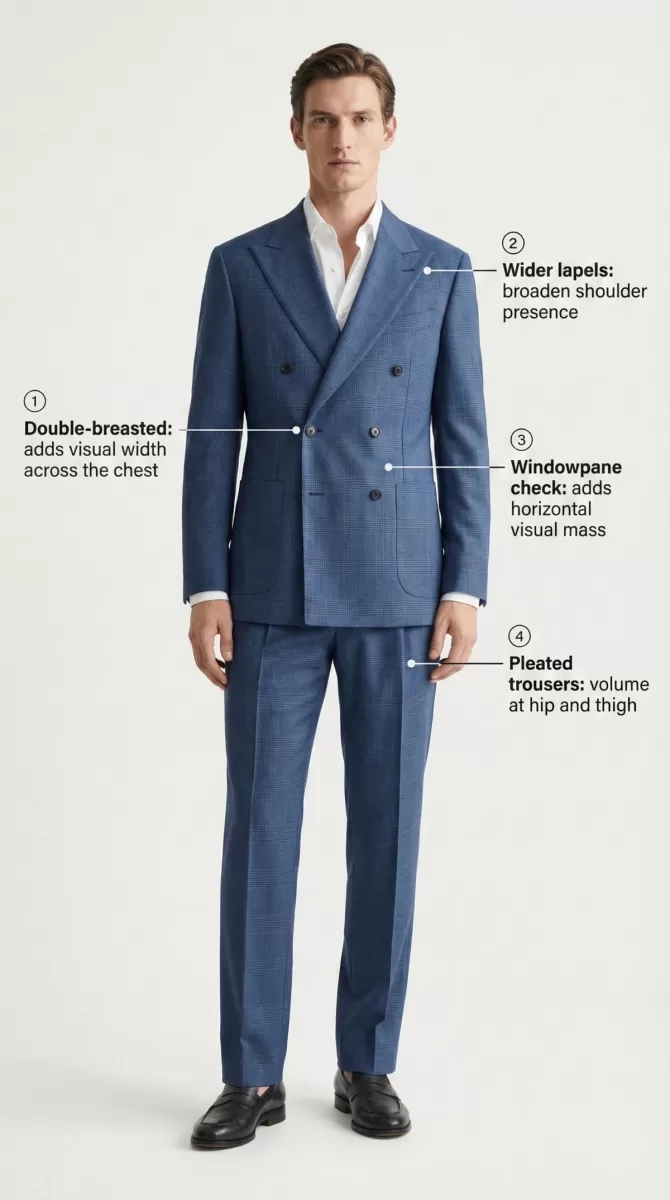
Tall and lean men have a natural advantage in that many tailoring proportions long jacket lengths, narrow lapels are designed with their silhouette in mind. The challenge is avoiding a garment that emphasises narrowness rather than adding visual presence.
What works:
-
Double-breasted jackets add visual width across the chest and create strong horizontal presence.
-
Wider lapels (3.5+ inches) broaden the shoulder line.
-
Subtle horizontal patterns pinstripes running horizontally, windowpane checks add visual mass.
-
The 2025–2026 generous silhouette is excellent for lean men: slightly broader shoulders and more relaxed chest avoid the "skeleton in a suit" appearance.
-
Pleated trousers add volume at the hip and thigh.
What to avoid:
-
Very narrow lapels and ultra-slim fits these emphasise narrowness and can make lean men appear underdeveloped in the suit rather than sharp within it.
-
Heavily suppressed waists that emphasise the narrowness of the torso.
9.3 How to wear a suit for athletic builds
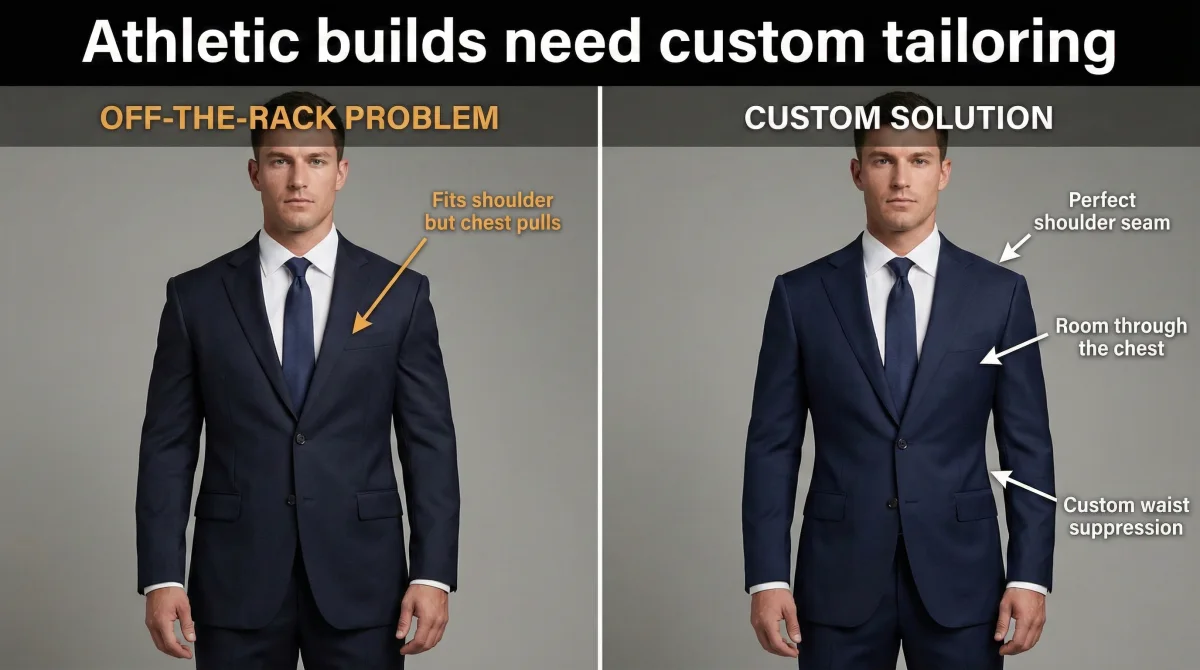
An athletic build broad shoulders, developed chest, narrow waist is simultaneously the most complementary physique for tailoring and the most difficult to fit in ready-to-wear.
Most RTW suit jackets are designed for proportional fits where the shoulder, chest, and waist increase in tandem. An athletic man's ratios diverge significantly from this block broad at the top, narrow below. The result is a jacket that either fits the shoulder (but pulls at the chest) or fits the chest (but swims at the shoulder).
Custom or made-to-measure tailoring is the cleanest solution. An athletic build deserves a jacket that fits the shoulder precisely, suppresses further at the waist than the standard block, and provides enough chest room for comfortable movement without pulling.
Custom suits for the perfect fit
10. How to wear a suit in different climates and seasons
Season and geography determine fabric weight, construction, and color elements that professional dressers adjust automatically but that many men overlook entirely.
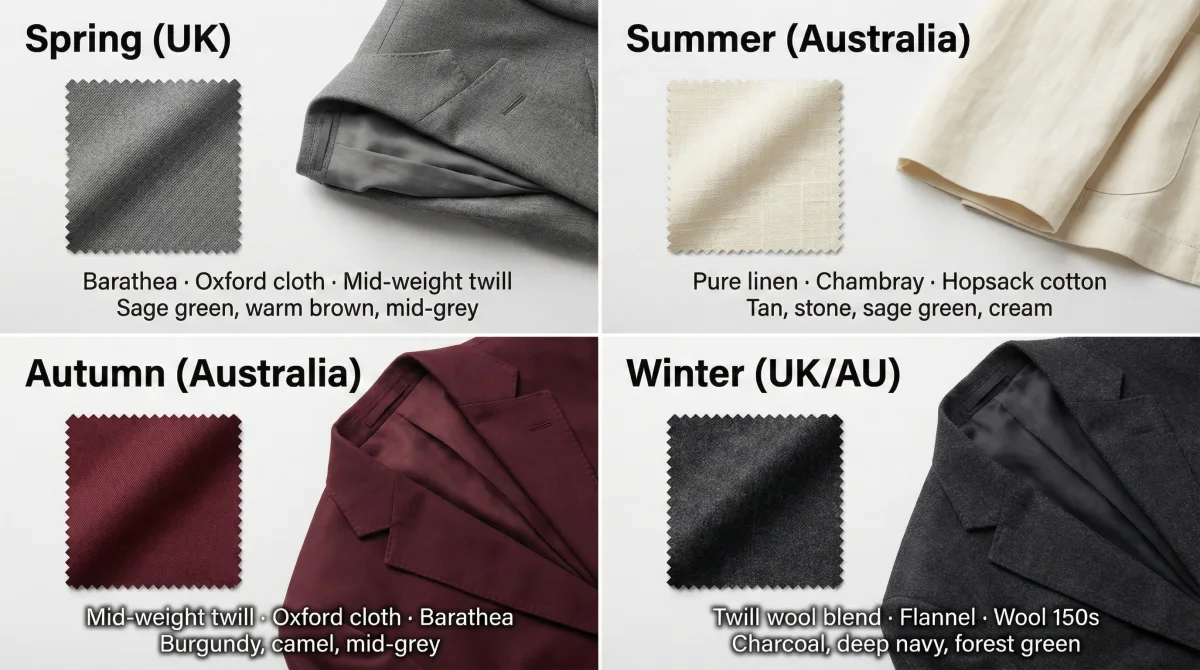
10.1 How to wear a suit for summer in Australia
The Australian summer presents several challenges for suiting: intense heat, high humidity in coastal cities, and outdoor venues that demand comfort alongside formality. The strategy is to reduce fabric weight wherever possible while maintaining a clean, dressed silhouette.
Fabric recommendations:
-
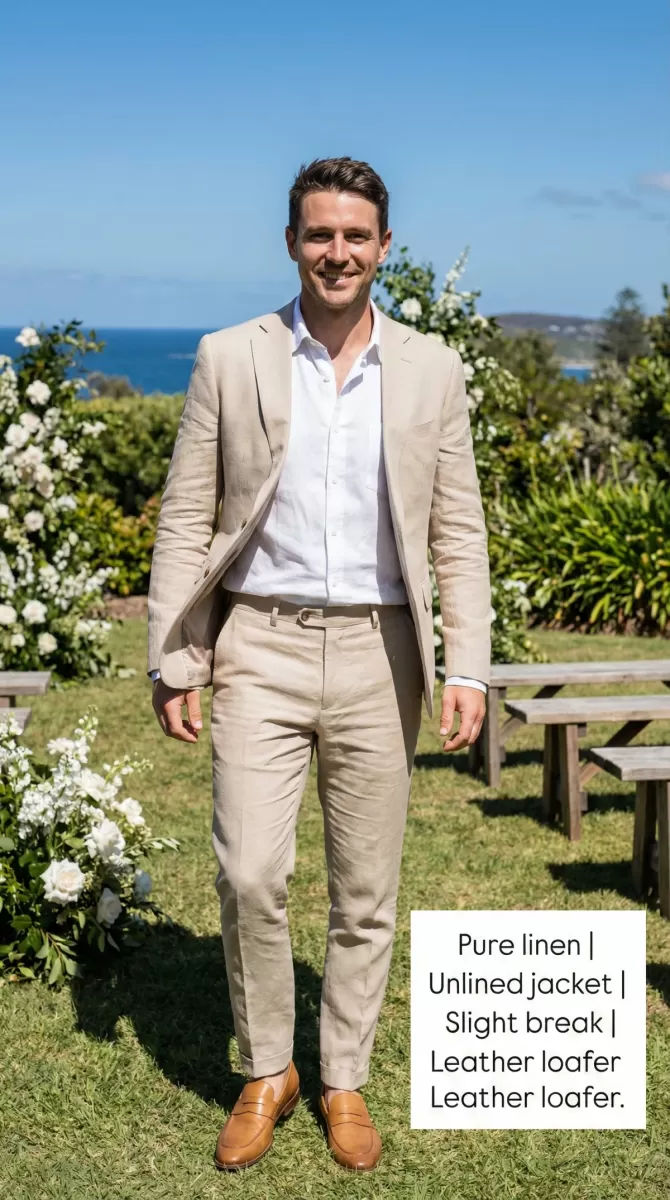
Pure linen: The ultimate summer fabric. Breathable, lightweight, and beautiful in tan, stone, and cream. Creases naturally a feature, not a flaw.
-
chambray: A lightweight, plain-weave cotton that resists heat beautifully. Available in Dunnio Tailor's premium fabric range ($99–$135).
-
Hopsack or cotton blend: Open weave fabrics that maximise airflow. Excellent for beach and garden weddings.
-
Plain cotton blend: Structured enough for formal events; breathable enough for summer warmth.
-
Color strategy for Australian summer: Sandy tan, stone, pale cream, sage green, and coastal blue reflect heat and complement the Australian coastal and garden wedding aesthetic far more naturally than heavy dark wools.
- Construction tip: Choose an unlined or half-lined jacket for maximum breathability. A heavily padded, fully lined jacket in Australian summer heat is both uncomfortable and impractical.
Tailored linen wedding suits for warmth
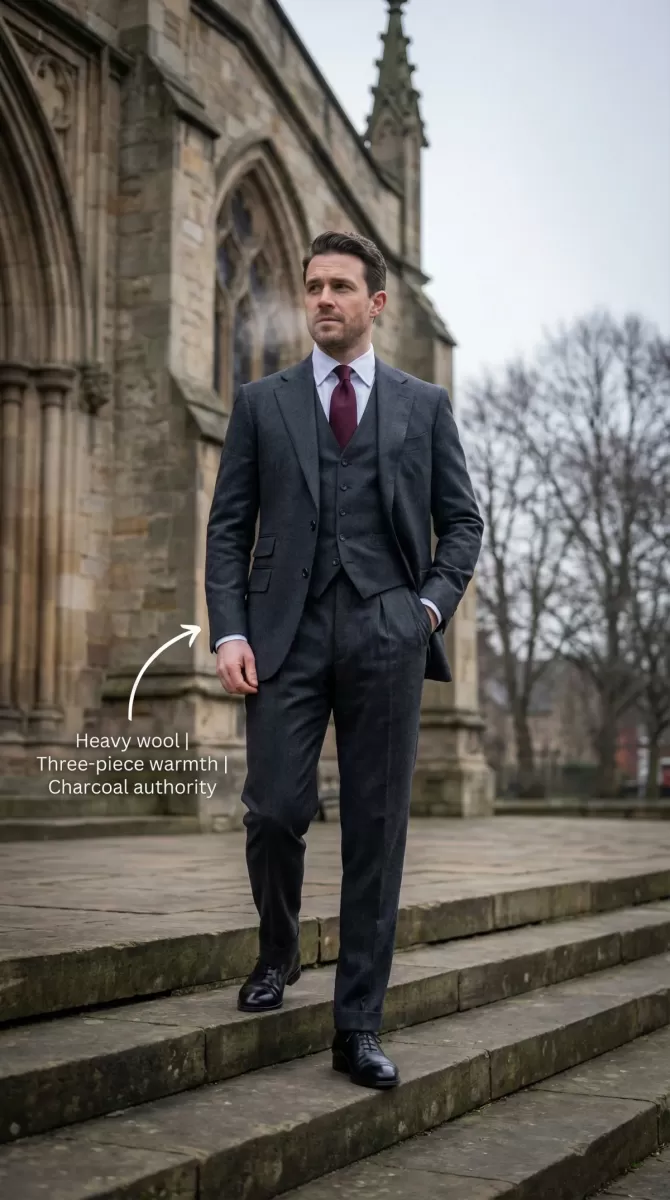
10.2 How to wear a suit for winter in Australia and the uk
Winter dressing in Melbourne, Sydney, London, and Edinburgh calls for heavier, denser fabrics that retain warmth while maintaining a sharp silhouette.
Fabric recommendations:
-
Twill wool blend: A structured winter fabric with excellent drape and weight. Available from Dunnio Tailor's luxury mill range at $231.
-
Wool 150s: An ultra-premium, tightly woven worsted wool that provides warmth without bulk. The benchmark of winter suiting quality.
-
Flannel: A brushed, matte wool that is one of the most comfortable winter suit fabrics. Projects understated sophistication.
-
Tweed: Traditionally rough-textured, tweed is ideal for country events, autumn weddings, and transitional formal occasions in the UK.
-
Color strategy for winter: Charcoal grey, deep navy, forest green, and rich burgundy suit the light levels and atmosphere of winter in both Australian and British contexts.
- Layering: A waistcoat (vest) serves both a functional and aesthetic purpose in winter adding a layer of insulation while elevating the jacket-and-trousers combination to three-piece formality.
10.3 How to wear a suit for spring and autumn the transitional seasons
Spring in the UK and autumn in Australia share a similar challenge: unpredictable temperatures that require fabric versatility.
Best transitional fabrics:
-
Barathea: A fine, tight weave that holds warmth without heaviness ideal for spring evenings or autumn wednesdays.
-
Oxford cloth: A durable, mid-weight cotton that works across a wide temperature range.
-
Mid-weight twill: Sits between summer hopsack and winter flannel versatile and structured.
- Transitional colors: Sage green, warm mid-brown, burgundy, and classic mid-grey all read as autumnal or vernal without being season-specific. A charcoal or navy suit in a mid-weight fabric transitions between professional environments and social settings effortlessly.
- Smart strategy: A three-piece suit in a mid-weight fabric gives maximum flexibility jacket can be removed in warmer conditions while the waistcoat maintains the dressed-up appearance.
Design your 3-piece suit in 3D virtual
11. Suit trends to know in 2025–2026
The suiting landscape of 2025 and 2026 is defined by a meaningful departure from the ultra-slim-fit aesthetic that dominated the previous decade. The new direction is more relaxed, more architectural, and more connected to sustainability and quality craftsmanship.
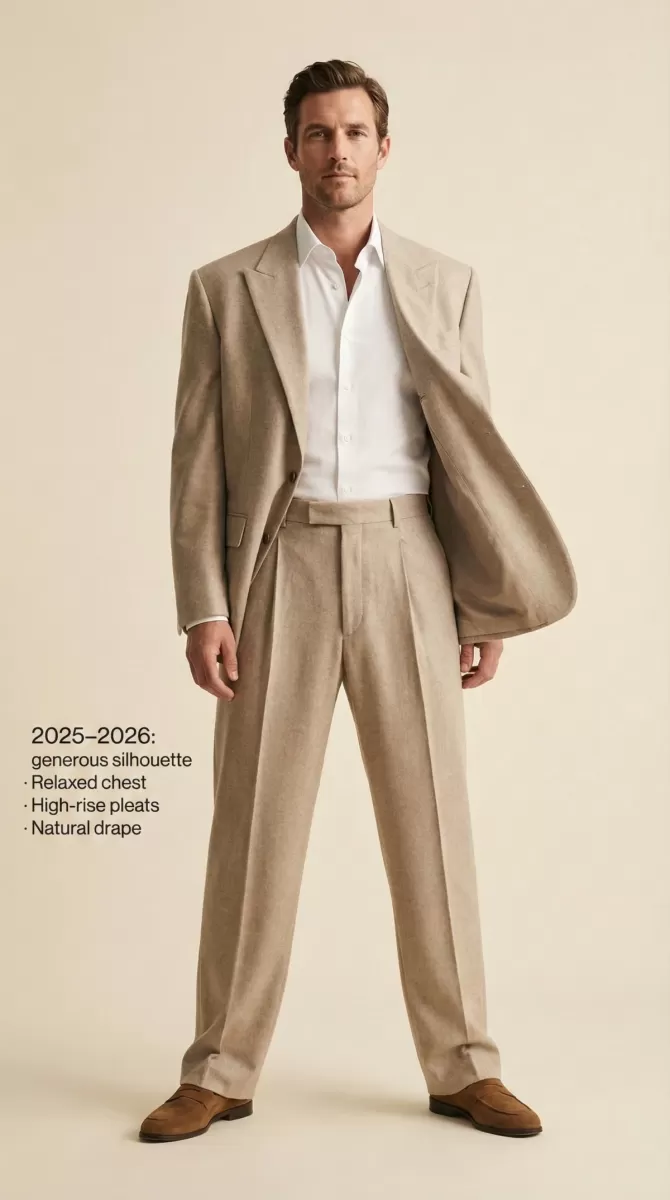
11.1 The generous silhouette
The dominant silhouette in 2025 and 2026 features:
-
Slightly broader, squarer shoulders that frame the frame rather than cling to it.
-
A more relaxed chest with room for natural movement.
-
Returning to higher-rise, pleated trousers a move back toward Italian and British tailoring traditions.
-
An overall "architectural drape" that allows fabric to fall beautifully without restricting the wearer.
This is not a return to the oversized or shapeless silhouettes of the 1990s it is a considered recalibration toward a suit that flatters through volume rather than compression.
11.2 The new neutral color palette
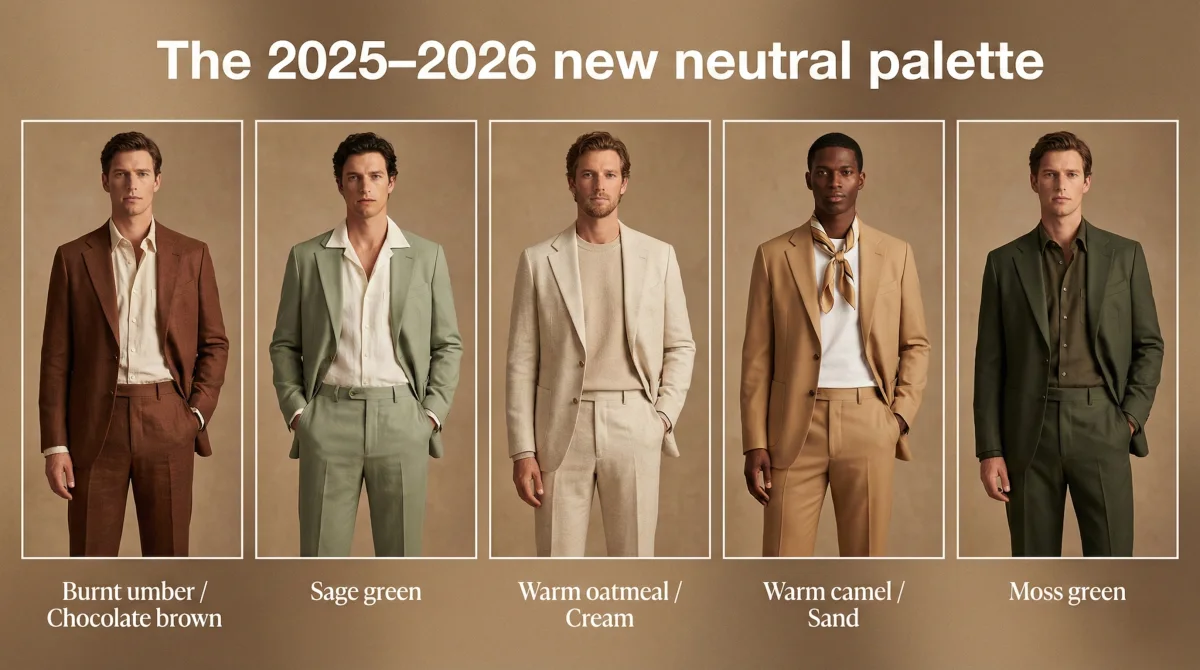
While navy blue and charcoal grey remain the essential foundations of any suiting wardrobe, 2025–2026 sees significant energy around earth-centric tones:
-
Burnt umber and chocolate brown.
-
Sage green and moss.
-
Warm oatmeal and cream.
-
Warm camel and sand.
These colors sit beautifully in both social and professional-creative environments and are increasingly seen on tailoring runways in London, Milan, and Sydney.
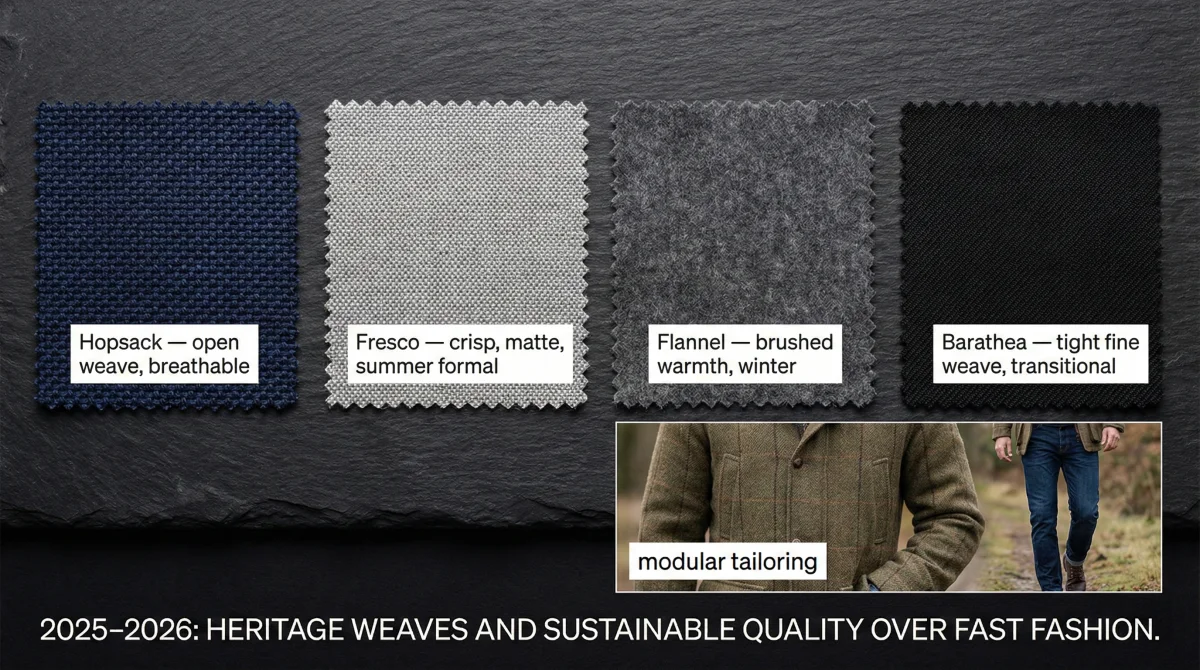
11.3 Heritage weaves and sustainability
Consumer trends in 2025 and 2026 are moving toward intentional, long-term investment in quality rather than disposable fast fashion:
-
Heritage weaves: Hopsack, fresco, flannel, and barathea are in strong demand after years of smooth-surface fabrics dominating.
-
Natural blends: Wool with bamboo, silk-linen hybrids, and recycled fibre blends address both performance needs and environmental values.
-
Modular tailoring: Suit jackets designed to be worn as separates paired with denim or knit trousers extending the garment's use and value beyond formal settings.
For a broader view of suit architecture, cultural nuances, and historical context, read the architecture of elegance: a comprehensive guide to men's suits and tuxedos.
12. Why a custom suit makes how to wear a suit easier
The rules covered in this guide are simpler to follow when the suit is designed around your body rather than adjusted to accommodate it. When fit is handled correctly from the start, most of the common errors collar gaps, bottom-button temptation, trouser drag disappear before they begin.
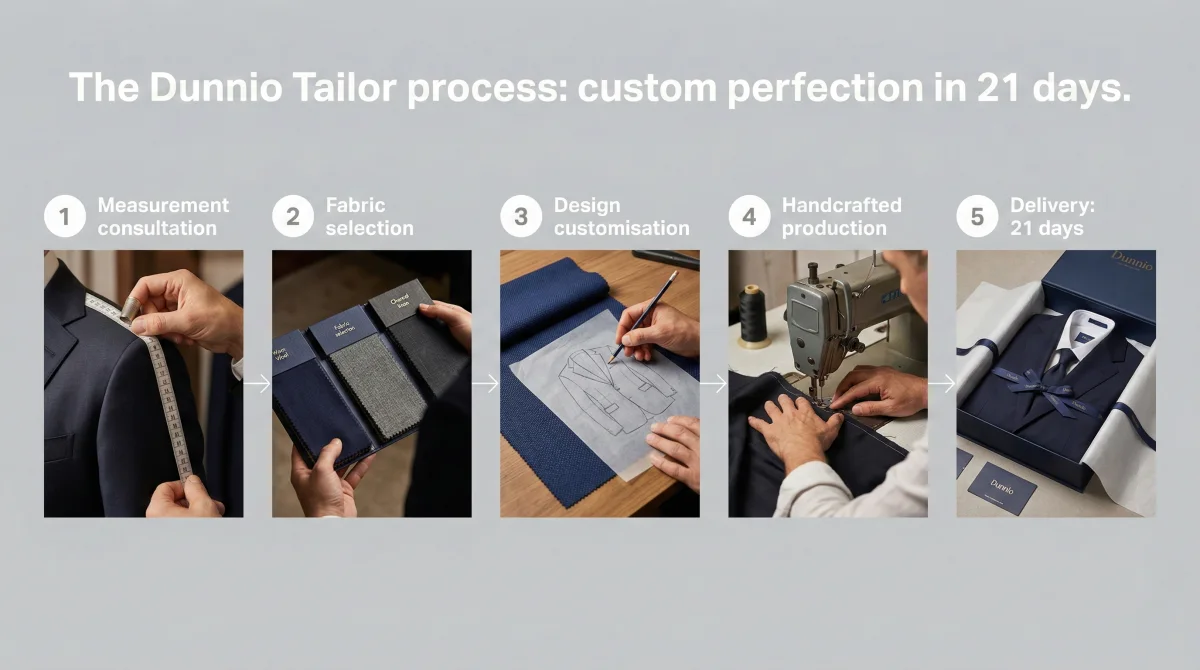
12.1 The Dunnio Tailor process
Dunnio Tailor offers fully custom, handcrafted suits built to your individual measurements. The process:
-
Measurement consultation: Every cut begins with precise body measurements shoulders, chest, waist, arms, inseam, rise, and more.
-
Fabric selection: Choose from premium fabrics ($99–$135 range: twill, oxford, chambray, barathea, satin, hopsack cotton blend, plain cotton blend, pure linen) or luxury mill fabrics ($231: twill wool blends, Wool 150s). Custom or specialty fabrics are also available on request.
-
Design customisation: Lapel style, vent configuration, pocket style, lining, and button choice are all fully personalised.
-
Handcrafted production: Each garment is constructed by skilled craftsmen.
-
Delivery: Ready in 21 days.
Dunnio Tailor's approach eliminates the most common sources of suit-wearing errors. A jacket that fits perfectly needs no heroic buttoning strategy. Trousers that sit correctly at the natural waist and fall to the right break require no adjustment at the collar.
Read more about why bespoke tailoring solves problems that off-the-rack cannot in how Dunnio Tailor's bespoke approach eliminates the pain points of off-the-rack suits.
12.2 Explore and design in 3D
Dunnio Tailor's 3D design experience allows you to visualise your suit in full before ordering choosing fabric, color, lapel style, and construction details in an interactive environment.
13. Frequently asked questions about how to wear a suit
13.1 Should the bottom button of a suit jacket always stay undone?
Yes. The bottom button of a suit jacket is never fastened on a two-button jacket, the bottom button remains open at all times. On a three-button jacket, the bottom button also remains open. This is a fundamental rule of how to wear a suit that applies regardless of brand, price, or occasion.
13.2 How much shirt cuff should show?
Approximately 1.5 cm (half an inch) of shirt cuff should be visible below the jacket sleeve. This small detail signals that both the jacket and shirt are the correct length. If the jacket entirely covers the shirt cuff, it is too long. If more than an inch of shirt is exposed, the jacket sleeves are too short.
13.3 Should I unbutton my suit jacket when sitting down?
Always. Unbuttoning the jacket when seated protects the garment, prevents stress on the buttons and seams, and avoids the jacket from bunching at the collar. Refasten the jacket when standing.
13.4 What is the correct trouser break for a modern suit?
The modern professional standard is a "slight break" a single, subtle fold where the trouser hem meets the shoe. A "no break" hem (trouser just skims the shoe top) is contemporary and clean. A "full break" with multiple folds of fabric at the ankle is considered dated in most modern contexts.
13.5 Can I wear a suit without a tie?
Yes, in most non-formal contexts. The tieless suit look requires a well-fitted shirt collar that sits cleanly against the jacket collar, and a suit fabric that reads as polished rather than casual. This look works well for cocktail events, smart casual dinners, creative professional environments, and social occasions. For black-tie and formal morning dress, a tie or bow tie remains mandatory.
13.6 Should a belt and shoes always match in color?
In any professional or formal context, yes. The belt color must match the shoe color brown belt with brown shoes; black belt with black shoes. The leather strap of a dress watch should also match. This rule may be relaxed in smart casual and creative settings, but it is never wrong to follow it.
13.7 How do I know if a suit jacket fits properly?
Check these five points:
-
Shoulder seam sits exactly at the edge of the shoulder bone.
-
No pulling or bunching across the chest when buttoned.
-
A flat hand fits between your chest and the buttoned jacket with slight room.
-
The jacket hem falls to approximately knuckle level when arms are at your sides.
-
Approximately 1.5 cm of shirt cuff is visible below the jacket sleeve.
13.8 What is the most versatile suit color for men?
Navy blue is the single most versatile suit color in a man's wardrobe. It is appropriate for business formal and business casual settings, daytime weddings, cocktail events, and social occasions. It complements most skin tones and pairs naturally with virtually every shirt and accessory color combination.
13.9 How should a suit fit for a larger man?
Larger men benefit from a single-breasted jacket to avoid horizontal bulk, dark suit colors (navy or charcoal) for their slimming vertical effect, and a jacket that suppresses gently at the waist without pulling at the buttons. Trousers should have a slight break and a clean, uncluttered line from waist to hem. Custom tailoring is the most reliable solution because standard RTW sizing blocks rarely accommodate the proportions of a fuller build correctly.
13.10 What fabric is best for an Australian summer wedding?
Pure linen is the premier choice breathable, naturally cooling, and available in the light tones that suit the Australian summer palette. Chambray, hopsack cotton blend, and plain cotton blend are excellent alternatives. Avoid heavy wool and synthetic fused jackets in summer heat. Choose an unlined or half-lined jacket construction for maximum airflow.
Conclusion
Learning how to wear a suit well is a skill that pays dividends in every professional and social setting a man encounters. The principles outlined in this guide fit above all else, the fundamental rules of buttoning and cuff exposure, the grammar of accessories and shoes, the strategic use of suit colors and shades, tailoring styles matched to body type and climate, and an awareness of 2025–2026 trends form a complete and lasting framework.
The best version of how to wear a suit is the one built on a garment that fits you, rather than a garment you try to fit into. That distinction is the entire argument for custom tailoring.
At Dunnio Tailor, every suit begins with your measurements and ends with a handcrafted garment delivered in 21 days. Whether you are dressing for a boardroom, a beach wedding, a black-tie gala, or a creative cocktail evening, the team at Dunnio Tailor can guide your fabric and design choices from the very first measurement.