Table of Contents[Hide]
- 1. Why the collar is the most important detail in a man's shirt
- 2. How to identify your face shape: a practical guide for men
- 3. How to choose shirt collar based on face shape of men: the core pairing guide
- 3.1. Oval face: The versatile canvas
- 3.2. Round face: the elongation imperative
- 3.3. Square face: balancing angular power
- 3.4. Oblong (long or rectangular) face: adding width and visual mass
- 3.5. Heart-shaped face: Grounding the upper face
- 3.6. Diamond face: widening above and below the cheekbones
- 3.7. Master reference table: face shape × collar style
- 4. Beyond face shape: how body type and neck affect collar selection
- 5. The collar and the tie knot: a combined face-shaping system
- 6. Collar types decoded: a guide to every major shirt collar style
- 6.1. Classic point (straight-point) collar
- 6.2. Spread collar and semi-spread (Kent collar)
- 6.3. Cutaway collar (extreme spread or cutaway)
- 6.4. Button-down collar
- 6.5. Club collar (rounded collar)
- 6.6. Tab collar and pin collar
- 6.7. Mandarin (band) collar
- 6.8. Cuban / camp collar
- 6.9. Wingtip collar
- 6.10. Quick-reference collar summary table
- 7. Collar selection by occasion: what to wear and when
- 8. Collar care and construction: understanding what you are wearing
- 9. The Dunnio Tailor solution: custom shirt collars built for your face and body
- 10. Frequently asked questions about choosing shirt collar based on face shape
- Conclusion
1. Why the collar is the most important detail in a man's shirt
1.1. The collar as an architectural frame
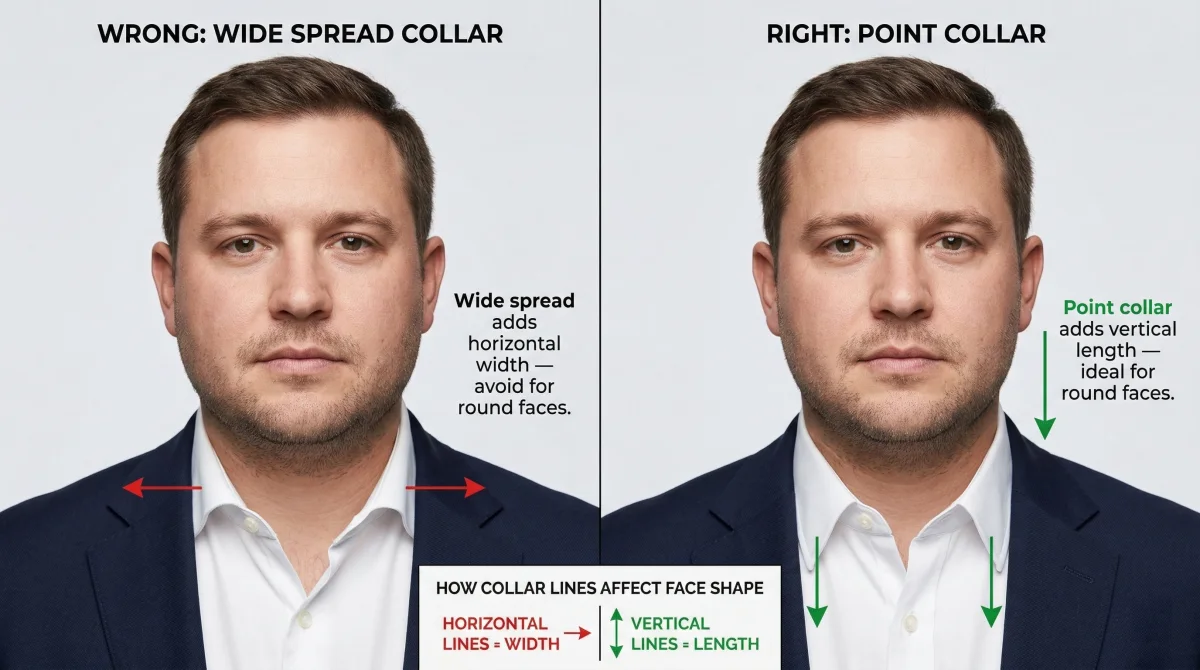
In tailoring, the discipline of choosing the right collar for a specific face is sometimes called corrective geometry. The principle is straightforward: a collar should provide the geometric opposite of the face's dominant features to create an impression of balance.
When a collar mimics the shape of the face for example, a narrow, elongated point collar on an already long, narrow face it amplifies those features to the point of imbalance. When it provides a contrasting shape, it creates the illusion of an ideal, well-proportioned oval.
The collar achieves this through two specific mechanisms:
- Vertical lines (created by narrow point collars and small tie knots) draw the eye downward and elongate the face useful for round or wide faces.
- Horizontal lines (created by wide spread collars and full Windsor knots) draw the eye outward and broaden the face useful for long, narrow, or oblong faces.
Understanding this core principle is the foundation of everything that follows.
1.2. The formality and proportion spectrum at a glance
| Collar type | Formality level | Best face shape | Best occasion |
|---|---|---|---|
| Classic point | High | Round, square | Business formal, interviews |
| Semi-spread / Kent | High/medium | Oval, round | Business, smart casual |
| Wide spread | High | Long, oblong, diamond | Professional, weddings |
| Cutaway / cutaway | High | Long, heart, diamond | European professional, weddings |
| Button-down | Medium/low | Square, oval | Business casual, smart casual |
| Club collar | Medium | Square, diamond, heart | Heritage, smart casual |
| Tab / pin collar | High | Round, square | Formal, black tie adjacent |
| Mandarin / band | Casual | Oval (with caution for most) | Resort, creative settings |
| Wingtip | Black tie only | All face shapes | Black tie, formal events |
| Cuban / camp | Casual | Oval, heart | Resort, warm weather |
2. How to identify your face shape: a practical guide for men
2.1. The six face shapes and their key features
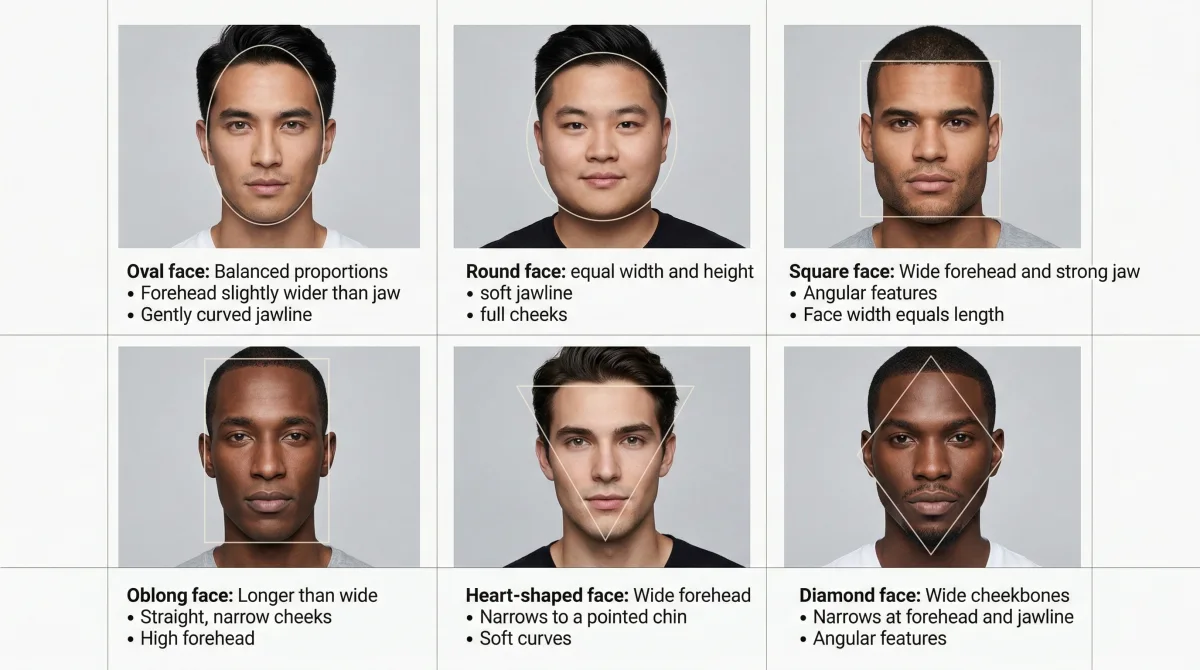
Before you can understand how to choose shirt collar based on face shape of men, you need to identify your own face shape with clarity. Here is what each shape looks like:
Oval face:
- Longer than it is wide, with soft, balanced proportions.
- Forehead is slightly wider than the jawline.
- Chin is gently rounded, narrower than the cheekbones.
- Often described as the most balanced face shape.
Round face:
- Width and length are roughly equal.
- Cheekbones are the widest part of the face.
- Jawline is soft and curved, with no strong angular definition.
- The face appears full and circular in outline.
Square face:
- Strong, angular jawline roughly equal in width to the forehead.
- Sides of the face are noticeably straight.
- The chin may have minimal rounding.
- Often perceived as a classically masculine structure.
Oblong (long or rectangular) face:
- Length is noticeably greater than width.
- Forehead, cheeks, and jawline have similar widths, creating a rectangular outline.
- The face can appear elongated or narrow.
Heart-shaped face:
- Broader forehead that narrows progressively to a pointed chin.
- Cheekbones are often prominent.
- The jawline is narrower than the forehead the reverse of a triangle.
Diamond face:
- High, prominent cheekbones that are the widest part of the face.
- Narrow forehead and narrow, angular chin.
- The overall shape tapers both above and below the cheekbones.
2.2. How to measure your face shape at home
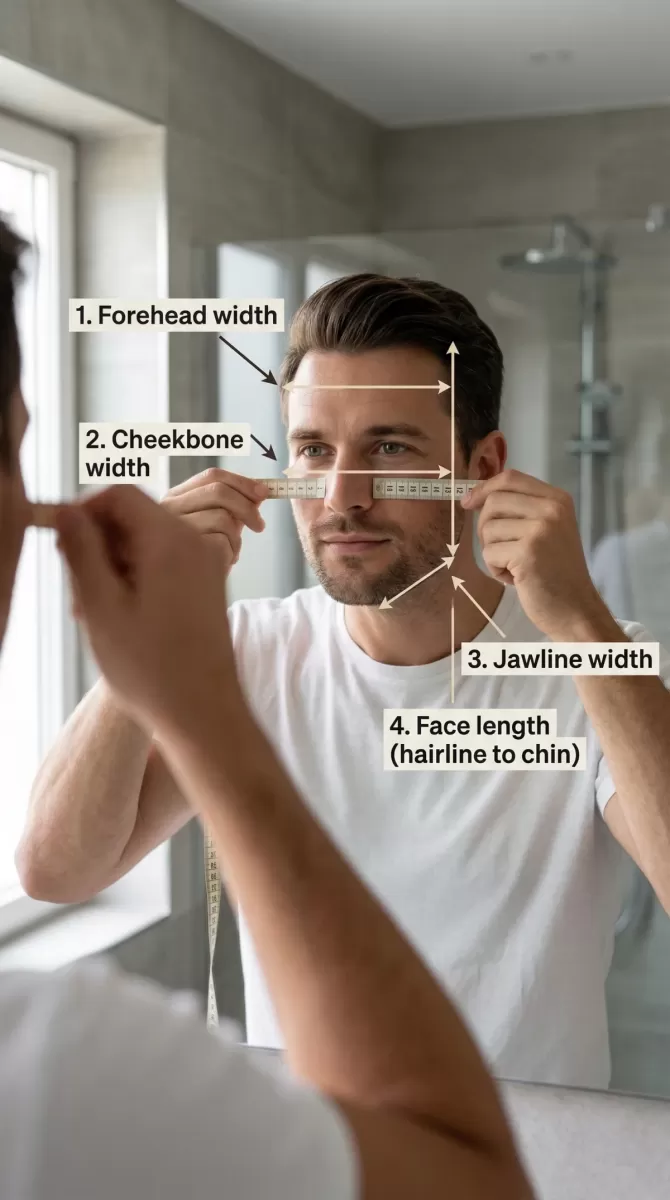
If you are unsure about your face shape, a quick measurement gives you objective data to work with:
- Measure your forehead width from hairline to hairline at its widest point, typically above the eyebrows.
- Measure your cheekbone width from the outer point of one cheekbone to the other.
- Measure your jawline width from the outer edge of one jaw angle to the other.
- Measure your face length from the center of your hairline to the tip of your chin.
Compare proportions: if width and length are roughly equal, you likely have a round face. If length significantly exceeds width, you are likely oblong. If your forehead and jaw are both narrower than your cheekbones, you likely have a diamond face.
2.3. Quick-reference face shape identification table
| Face shape | Key characteristic | Primary visual challenge | Collar goal |
|---|---|---|---|
| Oval | Balanced, slightly longer than wide | None already proportional | Maintain balance |
| Round | Equal width and height, soft jaw | Appears wide, lacks definition | Elongate and slim |
| Square | Strong angular jaw, straight sides | Can look harsh or blocky | Soften and balance |
| Oblong | Noticeably longer than wide | Can look thin or gaunt | Add horizontal width |
| Heart | Wide forehead, narrow pointed chin | Upper face dominates | Balance upper and lower |
| Diamond | Wide cheekbones, narrow forehead and chin | Cheekbones dominate | Widen forehead and jawline |
3. How to choose shirt collar based on face shape of men: the core pairing guide
3.1. Oval face: The versatile canvas
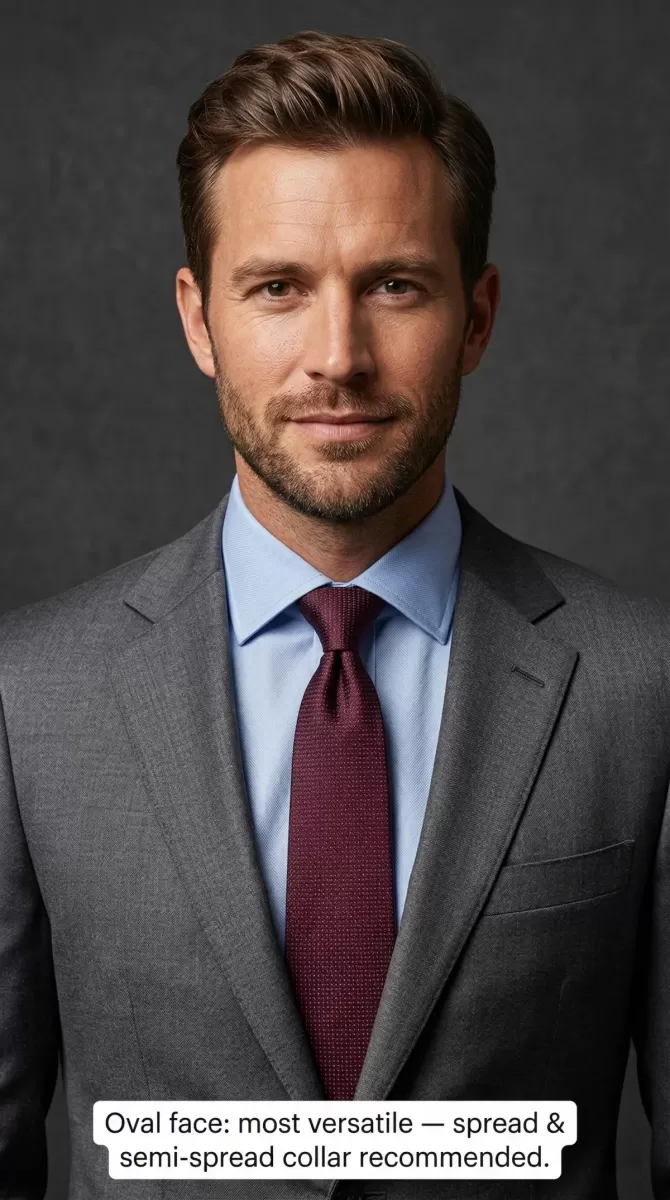
The oval face shape is often cited as the most balanced of all facial structures. Because the face is only slightly longer than it is wide, with soft transitions and proportional cheekbones, it does not require corrective geometry. Men with an oval face can wear virtually any collar without creating imbalance.
Best collars for oval face men:
- Spread collar and semi-spread maintain natural symmetry and frame the face elegantly.
- Button-down collar relaxed, versatile, adds casual refinement.
- Classic point collar clean and formal; works well with a four-in-hand knot.
- Tab collar adds a vertical lift if you want additional definition.
Styles to approach with some care:
- Excessively narrow point collars can add unwanted length over time.
- Extremely wide cutaway collars the contrast may work against the natural face balance.
For most occasions, the oval-faced man should focus on collar formality rather than face correction. Choose your collar based on the setting and the required tie knot, not on geometry.
3.2. Round face: the elongation imperative
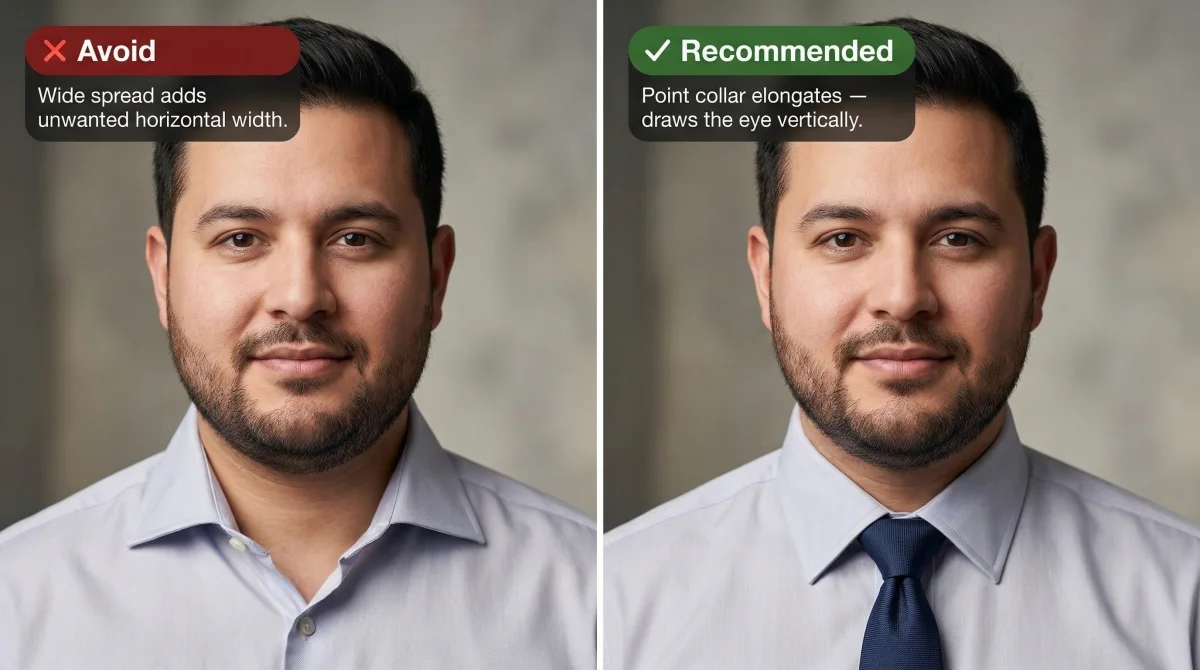
The round face presents the clearest geometric challenge in collar selection. With soft contours, full cheeks, and no strong jawline definition, the face reads as circular. The collar must introduce vertical lines that draw the eye upward and downward never outward.
Best shirt collar for round face men:
- Classic point (narrow point) collar: The defining choice. Narrow points and a minimal spread create a strong vertical axis that elongates the face and adds the illusion of a sharper jaw. This is the single most effective tool for a round-faced man.
- Tab collar and pin collar: Pull the collar points together, lift the tie knot, and further emphasise the vertical axis. Excellent for formal occasions.
- Narrow spread collar: A subtle widening effect that counteracts roundness gently without drawing too much attention to the collar itself.
Styles to avoid:
- Wide spread or cutaway collars: horizontal lines that draw the eye outward, effectively widening the face further and shortening the appearance of the neck.
- Mandarin or band collar: no elongating structure at all the collarless look exposes the round jaw without any framing.
- Club collar (rounded points): rounded edges mirror the roundness of the face and amplify it.
Practical tip for round faces: Pair your point collar with a four-in-hand knot. The asymmetrical, slightly elongated shape of this knot adds to the vertical line the collar creates.
3.3. Square face: balancing angular power
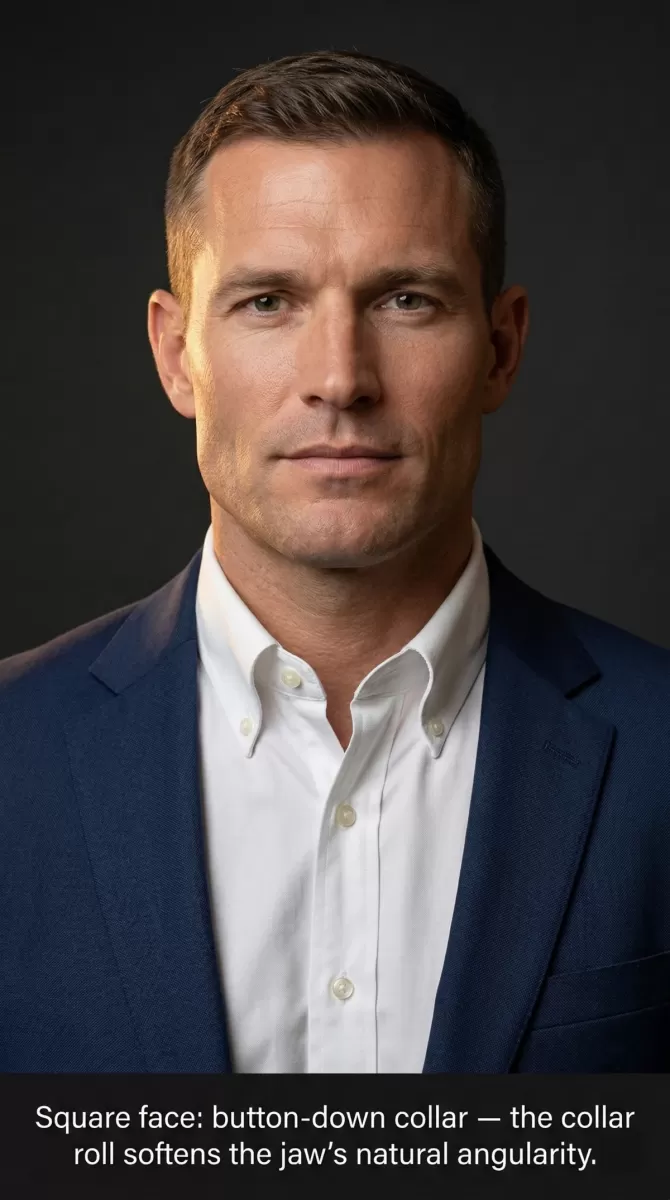
The square face is defined by its strong jawline and broad, angular structure. While commonly perceived as an asset in Western masculine aesthetics, an extremely square face paired with equally sharp collar geometry can produce an uncomfortably hard visual impression.
The goal is not to hide the jaw, but to soften it introducing a degree of curvature or moderate spread that contrasts with the natural angularity without competing with it.
Best shirt collar for square face men:
- Standard point collar: Provides enough vertical direction to frame the face without adding the spread that would widen an already broad structure.
- Medium spread / semi-spread collar: Offers a balanced width that complements the square proportions without emphasising the width of the jaw.
- Button-down collar: The natural collar roll where the points curve gently rather than lying flat softens the sharpness of the jaw. An excellent choice for business casual settings.
- Club collar (rounded points): Advanced, heritage-influenced choice. The softly rounded collar points introduce a circular element that directly counteracts the angular jaw.
Styles to approach carefully:
- Extreme cutaway collars: the dramatic horizontal spread can make a square jaw appear even broader and more pronounced.
- Very narrow, long point collars: the exaggerated length can make the strong jawline look more prominent than intended.
3.4. Oblong (long or rectangular) face: adding width and visual mass
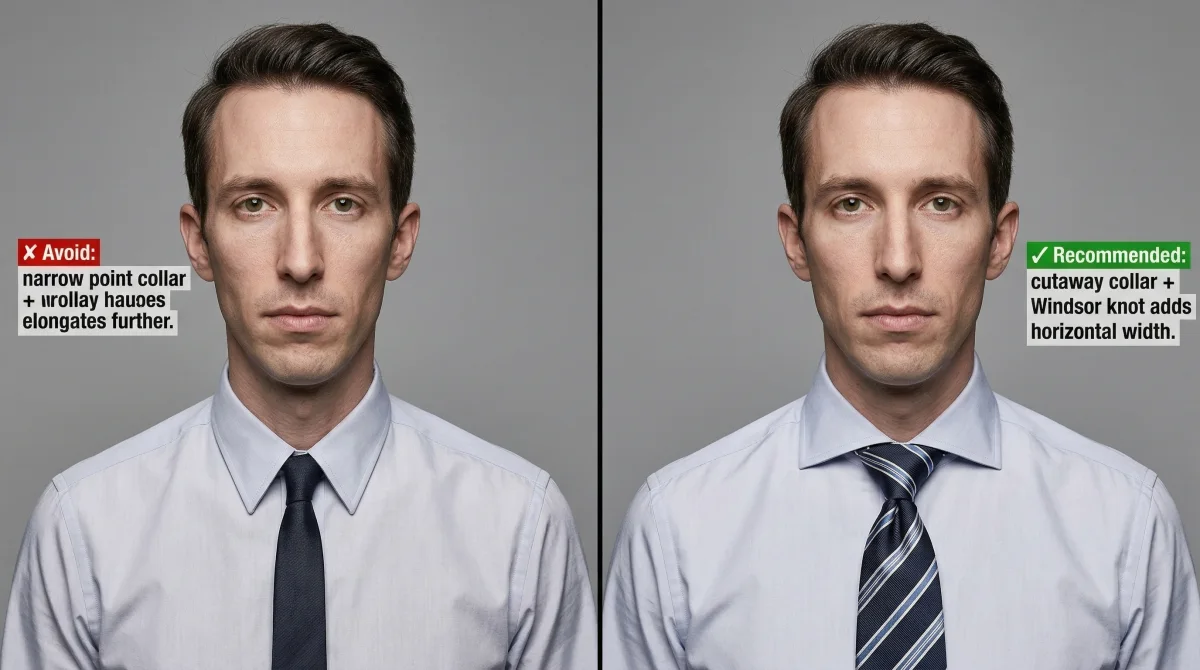
The oblong face is the inverse challenge of the round face: the face appears too long and too narrow. The collar must introduce horizontal lines that draw the eye across the face rather than through it much as a wide-belt adds visual width to a tall, slim frame.
Best shirt collar for long face men:
- Wide spread collar: The substantial distance between the collar points creates a broadening horizontal line across the neckline. This is the single most powerful tool for the oblong face.
- Cutaway collar: Points that angle backward toward the shoulders at near-180 degrees create a dramatically wide horizontal frame. This is the most effective choice for very long or narrow faces.
- English spread collar: A British preference that provides a powerful widening statement and suggests authority and physical presence.
Styles to avoid:
- Narrow point or long point collars: draw the eye downward along the length of the face, further exaggerating the elongated proportions.
- Tab collar: the vertical lift of the tab collar does the opposite of what an oblong face needs, adding perceived length.
- Very high collar stands: cover more of the neck, which further emphasises the vertical dimension of a long face.
The tie knot connection for long faces: A wide spread collar on an oblong face creates a large gap between the collar points. This gap must be filled by a substantial, symmetrical knot. A full Windsor knot is the natural companion its wide, triangular shape fills the collar opening and reinforces the horizontal broadening effect.
3.5. Heart-shaped face: Grounding the upper face
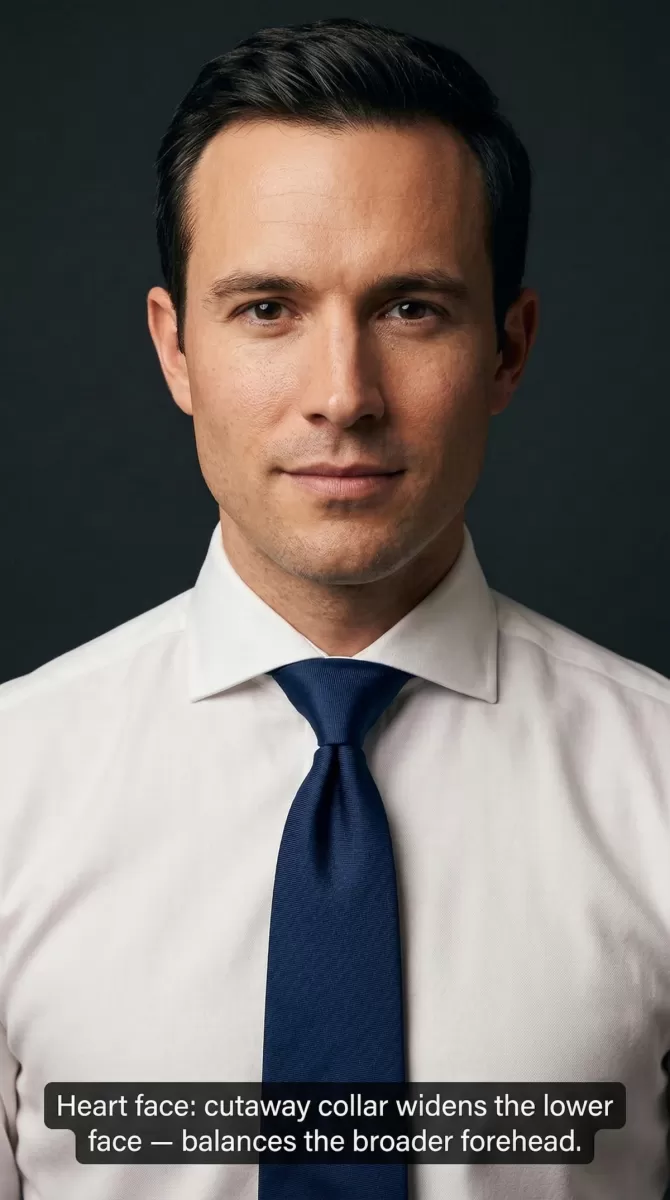
The heart-shaped face has visual weight concentrated at the top a broader forehead and narrows dramatically to a pointed chin. The collar must compensate by adding visual weight to the lower half of the face, broadening the perceived jawline and drawing attention away from the wide forehead.
Best shirt collar for heart-shaped face men:
- Cutaway collar: Opens widely and adds volume at the base of the throat, creating the illusion of a broader jaw and chin line.
- Wide spread collar: Similar effect to the cutaway broadens the lower face and distributes visual weight more evenly.
- Club collar (rounded points): The circular collar points add a softening element at the chin level, rounding out the pointed chin and creating a more balanced lower face impression.
Styles to avoid:
- Narrow point collar: draws the eye downward to the already narrow chin, accentuating the imbalance between upper and lower face.
- Mandarin collar: without any horizontal framing, the narrow chin and pointed lower face are left exposed and unbalanced.
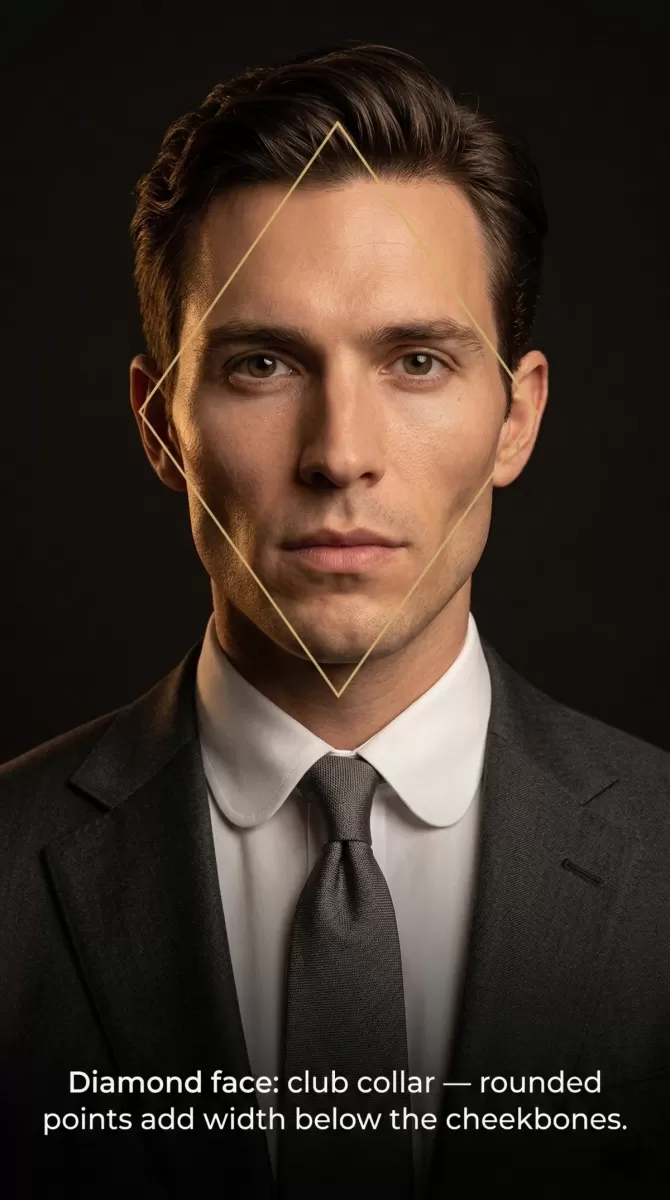
3.6. Diamond face: widening above and below the cheekbones
The diamond face presents a unique challenge: the cheekbones are the widest point, creating a narrow zone both above (forehead) and below (chin). The objective is to widen both the forehead and jaw areas visually, reducing the perception of dominant cheekbones.
Best shirt collar for diamond face men:
- Cutaway collar: Widens the jaw area effectively and reduces the visual dominance of the cheekbones.
- Spread collar and semi-spread: Provides horizontal broadening at the neckline, connecting the collar openings to the visual width of the lower face.
- Club collar (rounded points): The circular collar points add rounded volume at the chin level, helping to visually widen the narrow lower portion of the face.
Styles to avoid:
- Narrow point collar: concentrates the vertical line through the face, reinforcing the cheekbone dominance.
- Button-down collar: the moderate structure and downward-pointing buttons don't add enough horizontal mass to balance the prominent cheekbones.
3.7. Master reference table: face shape × collar style

| Face shape | Best collars | Avoid | Key principle |
|---|---|---|---|
| Oval | Spread, semi-spread, button-down, point | Extremely wide or narrow extremes | Maintain natural balance |
| Round | Point, narrow spread, tab, pin | Wide spread, cutaway, mandarin, club | Create vertical lines |
| Square | Standard point, medium spread, button-down, club | Extreme cutaway, very narrow point | Soften angularity |
| Oblong | Wide spread, cutaway, English spread | Long point, narrow point, tab | Add horizontal width |
| Heart | Cutaway, wide spread, club | Narrow point, mandarin | Broaden lower face |
| Diamond | Cutaway, spread, club, semi-spread | Narrow point, button-down | Balance above and below cheekbones |
4. Beyond face shape: how body type and neck affect collar selection
Knowing how to choose shirt collar based on face shape of men is the foundation but the full picture requires understanding two additional layers: neck proportions and overall body type. A collar that works perfectly for a man's face shape can still look wrong if it ignores the neck length or body frame.
4.1. Shirt collar for men with short necks
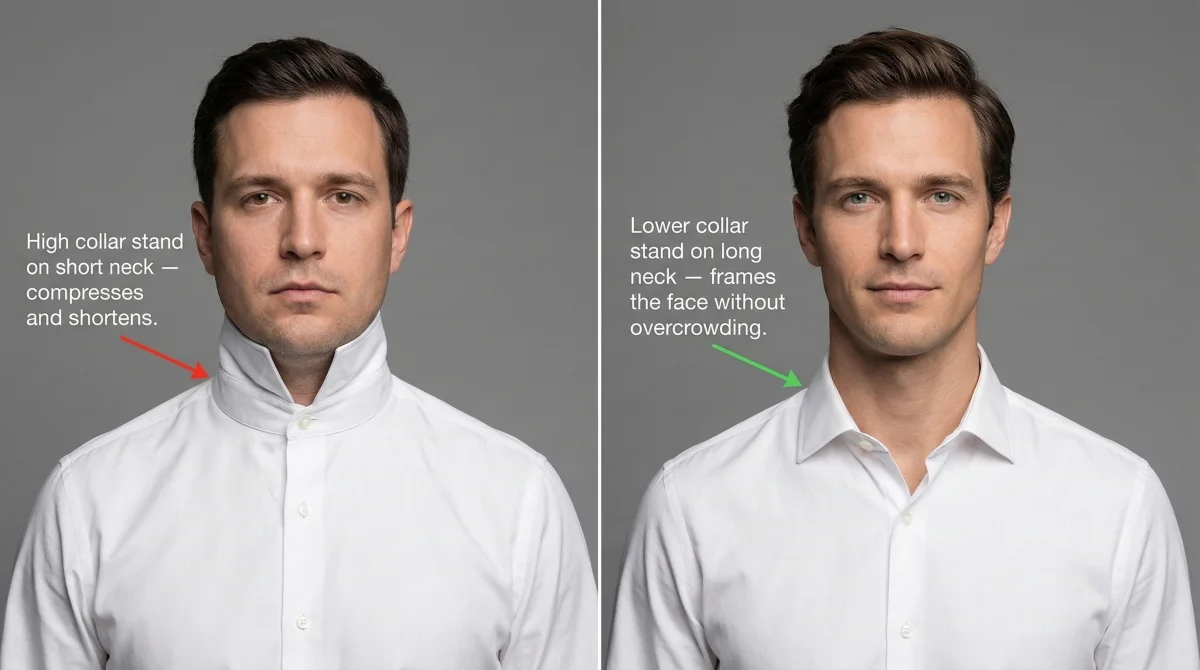
A short neck faces a specific challenge with the neck with collar relationship: a tall collar stand effectively buries the neck, making it look even shorter and creating an impression of heaviness around the throat.
- Choose collars with a lower stand height the vertical measurement of the band that wraps around the neck.
- Avoid wide spread collars with high stands that cover too much neck skin.
- A lower-cut collar, like the button-down, allows more neck to remain visible, visually elongating the neck area.
- Avoid turtlenecks or scarves styled up near the jaw they compound the visual compression.
Start designing your custom shirt
4.2. Shirt collar for men with long necks
Conversely, a tall collar stand is a valuable asset for a man with a long neck. Without sufficient collar height, the neck can appear exposed and disproportionately thin.
- Choose collars with a taller collar stand that covers more of the neck and provides a more substantial frame for the face.
- Semi-spread and spread collars with higher stands work well.
- The neck with collar relationship is most flattering when the collar stand is tall enough to meet the jaw without visible gap.
- A spread collar paired with a half-Windsor knot creates the ideal visual balance for a long-necked man.
4.3. Collar selection by shoulder width and body frame
The collar's spread interacts directly with the perceived width of the shoulders:
- Broad shoulders and wide frame: A medium spread or point collar provides a centred, streamlined look. A wide spread or cutaway on an already broad-shouldered man can over-emphasise the upper body width and create a visually top-heavy silhouette.
- Narrow frame and slimmer shoulders: A spread collar or semi-spread adds visual breadth to the upper body, creating a more substantial presence. The horizontal line of the collar opening mirrors the visual effect of a wider shoulder.
- Athletic or muscular "V-taper" build: A semi-spread collar balances the strong chest without adding further horizontal width. The goal is to draw the eye toward the face while the body's natural proportion speaks for itself.
4.4. Shirt collar for round face fat men
When a man has a round face and carries significant weight particularly around the face and neck the challenge of elongation becomes pronounced. The neck with collar relationship is further complicated by a heavier neck, which a tight collar can dig into uncomfortably.
- Choose point or narrow spread collars to introduce all possible vertical lines.
- Avoid tight collars: ensure a proper collar fit that does not cut into the neck the two-finger rule applies (you should be able to slide two fingers between the collar band and your neck when fully buttoned).
- Dark shirt colors navy, charcoal, deep burgundy recede visually and reduce the perception of bulk around the face and neck. Avoid light-colored shirts that draw attention to the face width.
- Avoid wide spread collars or cutaway collars that add horizontal emphasis.

4.5. Shirt collar for big-bellied men
Men who carry weight primarily around the midsection face a different challenge: the collar must draw the eye upward and away from the stomach rather than downward toward it.
- Embrace the point collar and semi-spread: These provide a clean, structured frame at the face without drawing attention downward.
- Pair with a tie when possible the vertical line of the tie creates a slimming axis from collar to belt, drawing the eye down the centre of the body rather than across it.
- Avoid wide-open cutaway collars with an open neck (no tie): the gaping collar opening draws the eye inward and downward toward the midsection.
- Ensure the collar fits properly a collar that constricts creates an uncomfortable visual ring around the neck that accentuates fullness above and below it.
4.6. Shirt collar for tall and slim / lean men
A tall, lean man has a natural advantage: he can wear collars that would be proportionally overwhelming on a shorter or heavier man.
- Spread and semi-spread collars add visual breadth to the face and upper body without the risk of looking too wide because the overall lean frame provides natural counterbalance.
- Avoid very narrow, long point collars that accentuate the already lean and elongated proportions.
- Layer the collar with a substantial tie knot (half-Windsor or Windsor) to add presence and visual weight at the neckline.
- A taller collar stand adds structure and definition to what might otherwise appear as a thin neck.
4.7. Shirt collar for short men
Short men benefit from collars that create vertical lines without adding horizontal mass or visual bulk at the neckline:
- Classic point or narrow spread collars with a four-in-hand knot create a clean, vertical axis that adds apparent height.
- Avoid very wide, dramatic cutaway collars that draw attention horizontally across the upper chest, which can visually compress the height.
- Proper collar fit is critical: a collar that is too large falls away from the neck and adds visual width; one that is too small appears to constrict the neck, making the head look disproportionately large.
5. The collar and the tie knot: a combined face-shaping system
5.1. Why collar spread dictates tie knot size
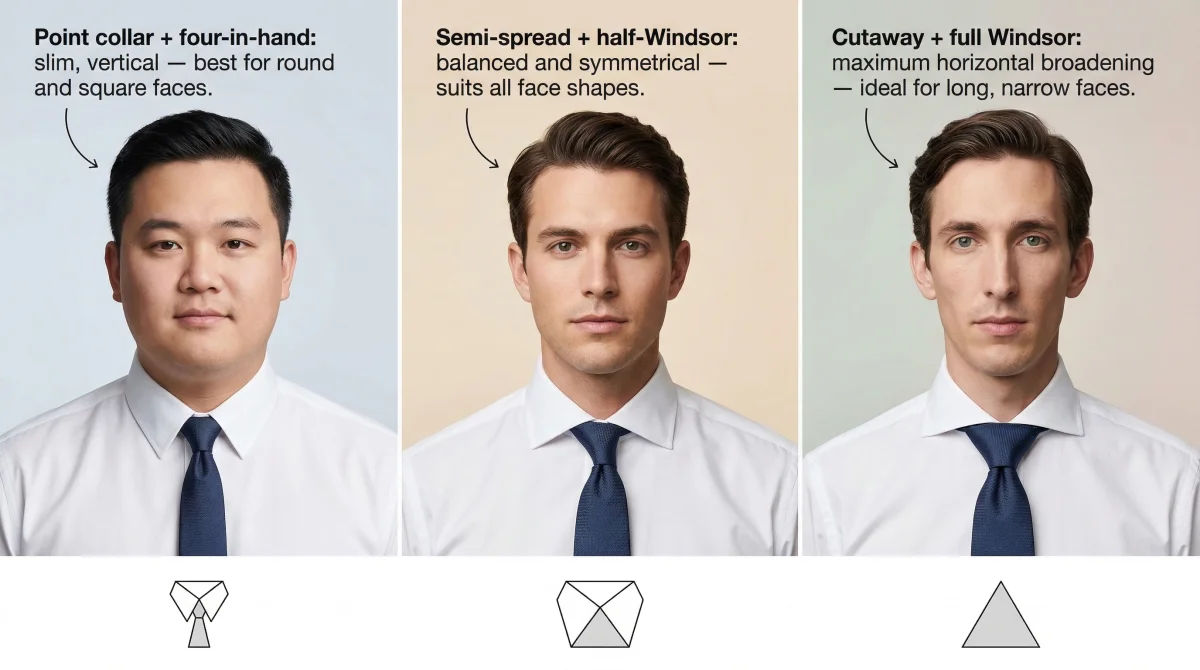
The collar and the tie knot do not function independently. The spread of the collar creates a triangular or V-shaped opening that must be filled appropriately by the knot. A mismatch between the two creates an appearance that is either cramped (too large a knot in a narrow collar) or sparse (too small a knot in a wide spread collar).
- Narrow spread / point collar: Requires a small, slightly elongated knot. The four-in-hand is the standard pairing its asymmetric, slender shape fits neatly within the narrow opening without strain.
- Medium spread / semi-spread collar: Accommodates a wider range of knots. The half-Windsor or Pratt (Shelby) knot provide a medium-sized symmetrical triangle that fills the opening naturally.
- Wide spread / cutaway collar: Requires a substantial, symmetrical knot. The full Windsor wide, triangular, and horizontally impressive is the ideal pairing. This combination adds the maximum horizontal width visual effect, making it perfect for long, narrow, or oblong faces.
5.2. The combined face effect: collar plus knot pairing table
| Collar type | Recommended knot | Knot size | Combined face visual effect | Best face shape |
|---|---|---|---|---|
| Classic point | Four-in-hand | Small, asymmetric | Strong vertical elongation | Round, square |
| Semi-spread | Half-Windsor, Pratt | Medium, symmetric | Balanced elongation and width | Oval, round |
| Wide spread | Full Windsor | Large, symmetric | Strong horizontal broadening | Oblong, long, narrow |
| Cutaway | Full Windsor | Large, symmetric | Maximum horizontal broadening | Heart, diamond, oblong |
| Button-down | Four-in-hand or no tie | Small or none | Moderate vertical/casual | Square, oval |
| Club collar | Small neat knots | Small | Softening + slight vertical | Diamond, square |
6. Collar types decoded: a guide to every major shirt collar style
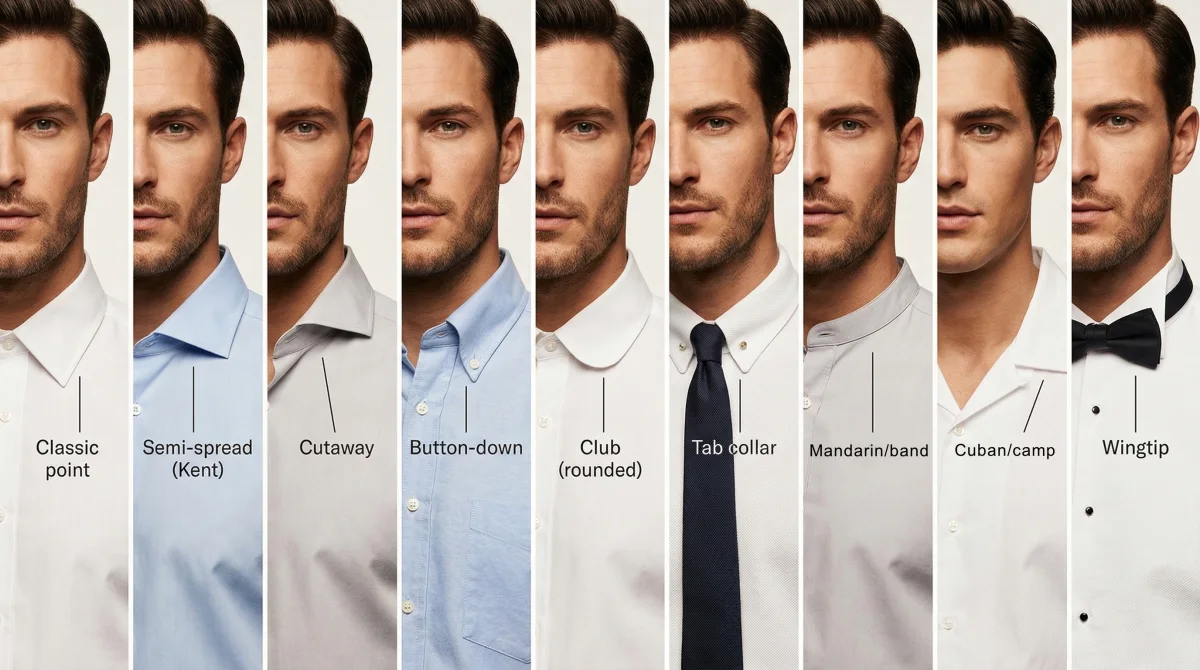
Understanding the full vocabulary of shirt collar styles allows you to apply the face shape pairings above with precision. Here is the complete reference guide:
6.1. Classic point (straight-point) collar
The quintessential formal collar. Narrow gap between points (1.5 to 3.5 inches), sits cleanly under a suit jacket without curling or lifting. Pairs with a four-in-hand knot. The most effective elongating collar for round and square faces.
6.2. Spread collar and semi-spread (Kent collar)
The spread collar exists on a spectrum from semi-spread (also called the Kent collar at heritage shirtmakers) to a moderate wide spread. The collar points angle away from each other, creating a wider opening that accommodates larger tie knots. Turnbull & Asser's Kent collar is a benchmark semi-spread.
6.3. Cutaway collar (extreme spread or cutaway)
Points angle at near-180 degrees or beyond, sometimes appearing to point backward toward the shoulders. An inherently bold, European-influenced collar. The collar gap is very wide and demands a full Windsor knot to fill it. The strongest possible horizontal broadening collar ideal for oblong, long, heart, and diamond faces.
6.4. Button-down collar
Invented by Brooks Brothers in 1896, inspired by polo players' collars. The defining feature is the small buttons that secure the collar points to the shirt front, preventing them from lifting. A well-made button-down has a natural "roll" where the collar curves gracefully rather than lying flat. Inherently more casual; excellent for business casual settings and oval or square faces.
6.5. Club collar (rounded collar)
Rounded collar points that soften the hard angles of a tie or an angular face. Associated with a vintage, academic aesthetic from the mid-20th century. Particularly effective for diamond and square faces, as the circular collar points introduce a contrasting softness against angular features.
6.6. Tab collar and pin collar
Specialised formal collars. The tab collar uses a fabric loop that buttons behind the tie, pulling the points together and lifting the tie knot higher on the chest. The pin collar uses a metal bar to achieve the same effect. Both add significant verticality excellent for round faces in formal settings.
6.7. Mandarin (band) collar
A short, stand-up fabric band (1 to 3 cm) with no points. Originating from Asian tailoring traditions, this collarless style cannot be worn with a tie. Works best in casual or creative professional settings. Suitable primarily for oval faces; generally inadvisable for round, heart, or diamond faces. Best in linen or lightweight cotton for warm-climate wear.
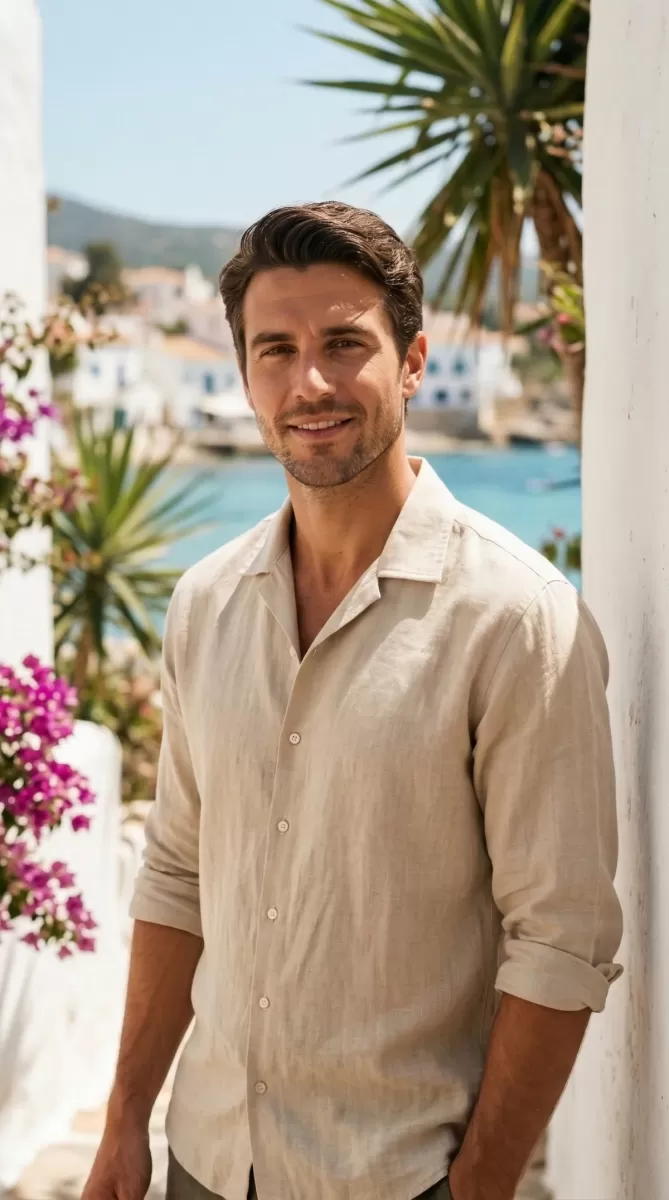
6.8. Cuban / camp collar
A flat, unstructured collar that lies open across the chest, unfastened. A staple of resort and warm-weather dressing. Optimal in linen, chambray, or lightweight cotton for tropical climates. Face shape rules are relaxed here the collar is too casual and informal to require precision pairing. Oval and heart faces wear it most naturally.
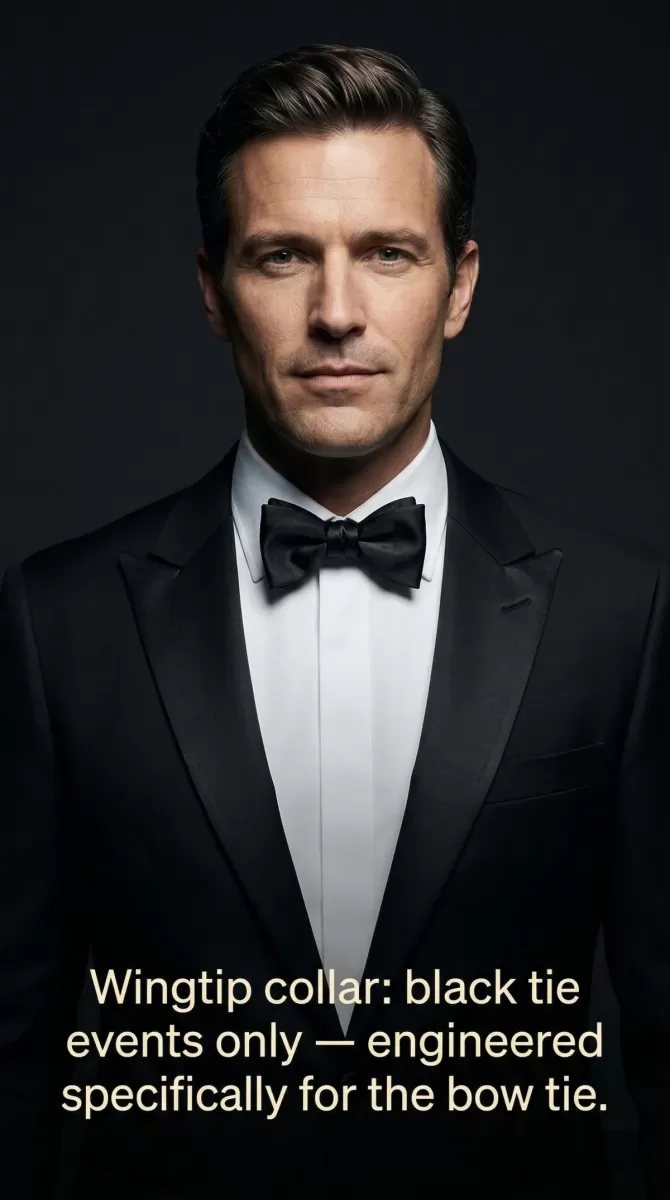
6.9. Wingtip collar
Reserved exclusively for black tie and formal events. The small, stiff points ("wings") fold downward on either side to accommodate a bow tie. It does not interact with face shape in the same way as everyday collars the formality of the overall ensemble is the primary framework. Pair with a custom tuxedo for maximum effect.
6.10. Quick-reference collar summary table
| Collar | Formality | Face shapes | Occasions |
|---|---|---|---|
| Classic point | High | Round, square, oval | Business, interviews |
| Semi-spread | High/medium | Oval, round, square | Business, smart casual |
| Wide spread | High | Oblong, diamond, heart | Business formal, weddings |
| Cutaway | High | Oblong, long, heart, diamond | European professional, weddings |
| Button-down | Medium/low | Square, oval | Business casual, casual |
| Club collar | Medium | Diamond, square, heart | Heritage, smart casual |
| Tab / pin | High | Round, square | Formal settings |
| Mandarin | Casual | Oval | Resort, creative professional |
| Cuban / camp | Casual | Oval, heart | Resort, summer, tropical |
| Wingtip | Black tie | All | Formal events, black tie |
7. Collar selection by occasion: what to wear and when
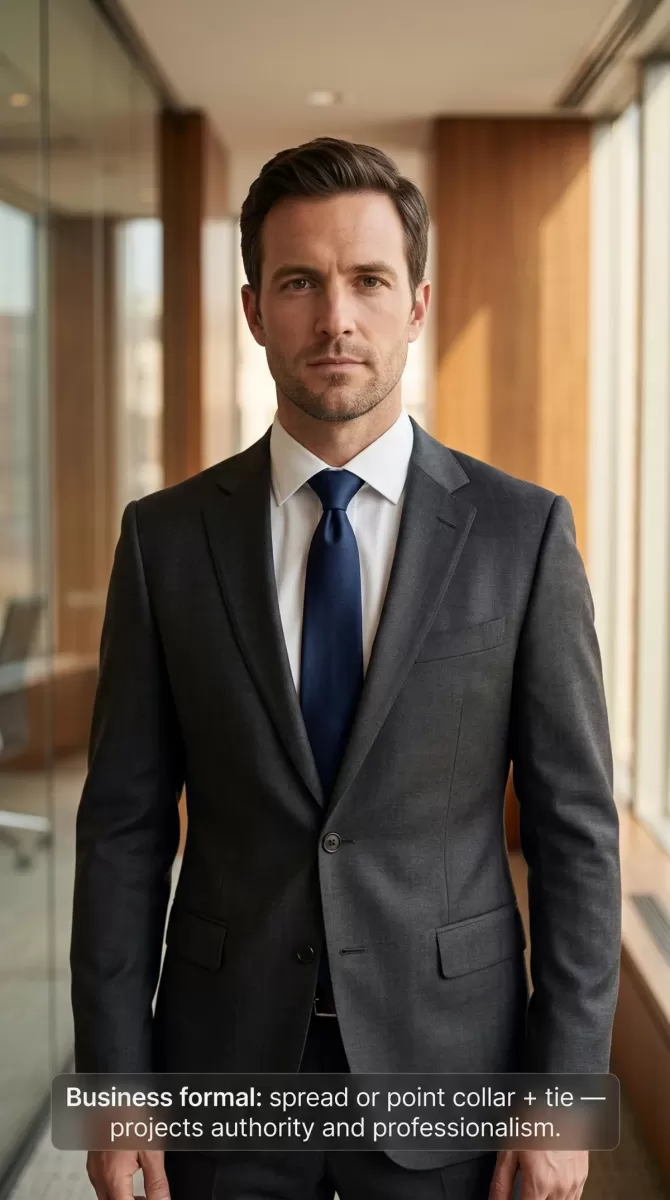
7.1. Business formal: interviews, boardroom, corporate settings
Recommended collar: Spread collar or classic point collar, always worn with a tie.
The classic point collar with a four-in-hand knot is the conservative choice that projects professionalism without visual risk. The semi-spread collar with a half-Windsor knot is the modern alternative slightly bolder and appropriate for industries where personality is valued alongside polish.
Pair with a custom suit or custom 3-piece suit for a complete, authoritative appearance. The collar, shirt, and suit must be considered as a single coordinated system not as three separate choices.
7.2. Business casual and hybrid professional environments
Recommended collar: Button-down collar or semi-spread collar, with or without a tie.
The button-down collar is the cornerstone of business casual dressing. It works with or without a tie, and its natural collar roll adds personality compared to the flat formality of a spread collar. A semi-spread without a tie, with the top button left open, is equally effective for modern hybrid offices.
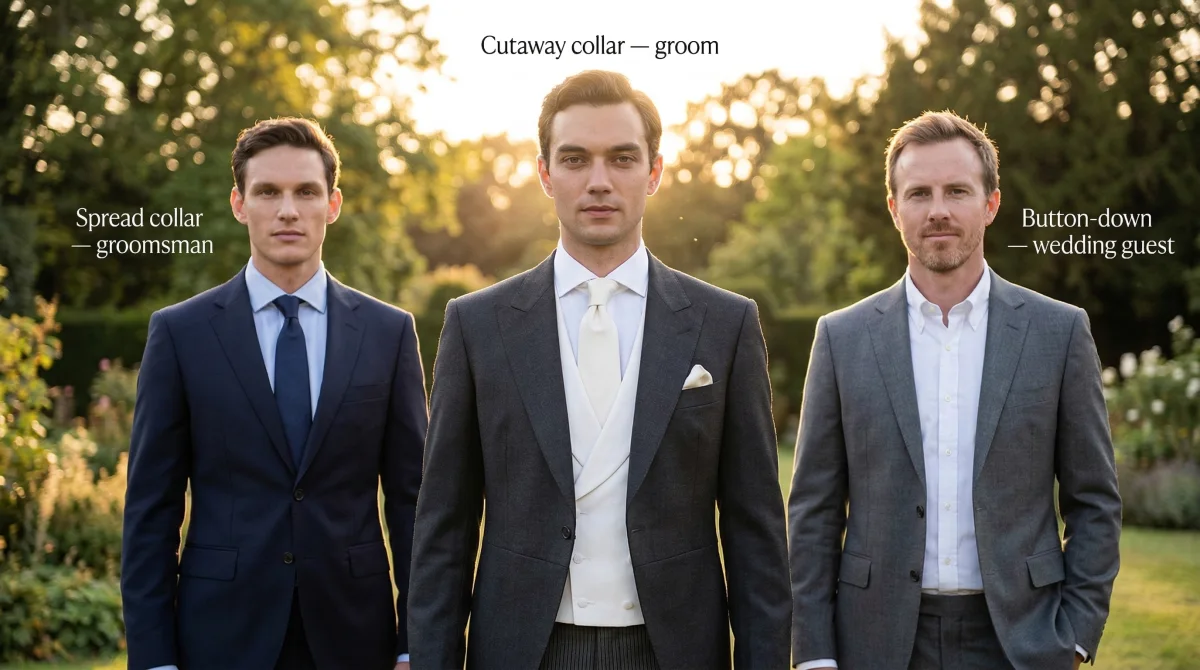
7.3. Weddings: groom, wedding party, and guests
- Groom collar recommendation: Wide spread or cutaway collar with a Windsor knot for maximum formality and visual presence. The wider collar fills the space created by a formal waistcoat or custom wedding vest and frames the face powerfully in photographs.
- Wedding party and guests: A spread or semi-spread collar with a half-Windsor knot provides elegance without competing with the groom's look.
For complete wedding coordination at Dunnio Tailor:
- Custom wedding suits
- Linen wedding suits lightweight and breathable for outdoor or warm-weather ceremonies
- Custom tuxedo for black tie weddings
- Custom 3-piece suits with a waistcoat for a fully structured wedding look
Design and visualise your complete wedding look with Dunnio Tailor's interactive 3D experience: suits | 3-piece suits | tuxedo | tuxedo shirts.
7.4. Casual and warm-climate settings
Recommended collar: Mandarin collar, Cuban/camp collar, or open button-down.
In tropical and warm climates Southeast Asia, Australia in summer, coastal resort settings the priority shifts from corrective geometry to breathability and comfort. Linen and chambray shirts with mandarin or Cuban collars perform best.
For most men in warm climates, the mandarin collar offers a sleek, minimal aesthetic that works effortlessly. The Cuban collar's relaxed, open-chest design suits beach-to-bar occasions. Neither requires a tie.
Fabric matters significantly in warm climates: at Dunnio Tailor, plain pure linen and chambray are available in the premium fabric tier ($99–$135) and are the recommended choices for tropical settings.
7.5. Black tie and formal events
Recommended collar: Wingtip collar with a black silk bow tie.
Black tie removes the face-shape variable almost entirely the requirements of black tie protocol define the collar choice regardless of facial structure. The wingtip collar's small, folded-down points are specifically engineered to showcase the bow tie knot.
Pair with a custom tuxedo and visualise the complete look with the 3D tuxedo configurator.
8. Collar care and construction: understanding what you are wearing
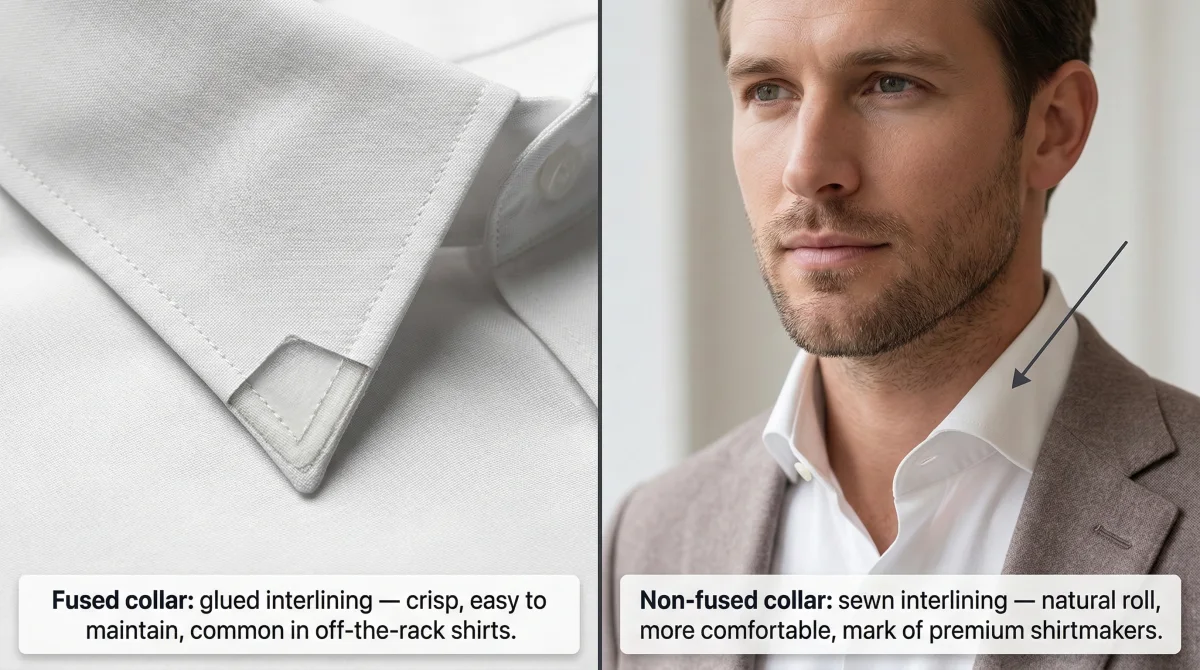
8.1. Fused vs. non-fused collar construction
The internal construction of a collar determines both its appearance and its longevity:
- Fused collar: An interlining is glued (fused) to the outer fabric. Creates a stiff, reliably crisp appearance. Easy to iron and maintain. Most off-the-rack shirts use fused collars. Lower-quality fusing can lead to bubbling or delamination after repeated laundering.
- Non-fused (floating) collar: The interlining is sewn rather than glued, allowing the layers to move independently. This is the hallmark of premium shirtmakers. Non-fused collars have a more natural, organic roll and are significantly more comfortable across the neck over a long day. They require slightly more care during ironing but maintain their quality over years rather than months.
For a custom shirt built around your face shape and neck proportions, a non-fused collar provides the most precise, lasting result.
8.2. Collar stays: what they are and why they matter
Collar stays are small inserts made of plastic, brass, or metal that slide into pockets on the underside of collar points. They prevent the points from curling upward or lifting away from the shirt during the day.
For men with round or square faces who rely on the point collar's elongating effect, collar stays are not optional they are the mechanism that keeps the collar points directed downward and maintaining the vertical line you need.
Always remove collar stays before washing or dry cleaning.
8.3. Basic collar care guidelines
- Wash shirts after each wear to remove oils and perspiration that accumulate at the collar band.
- Turn shirts inside out before laundering to protect the collar structure.
- Iron the collar while still slightly damp, using a steam iron on the appropriate fabric setting.
- Use a pressing cloth between the iron and the collar to protect delicate fabrics.
- Apply light spray starch to the collar before ironing if you prefer maximum crispness.
9. The Dunnio Tailor solution: custom shirt collars built for your face and body
9.1. Why off-the-rack collars fail most men
A standard off-the-rack shirt collar is engineered for a statistical average that represents no real person. It does not account for:
- Your specific face shape and the corrective geometry it requires.
- Your neck length and the stand height that would frame your face ideally.
- Your shoulder width and how collar spread interacts with your overall frame.
- Whether you have a round face and a big belly, or a long face and a short neck combinations that require a genuinely tailored collar geometry.
The result is a collar that fits "close enough" but close enough is not the same as right.
9.2. What custom collar tailoring delivers
A custom shirt from Dunnio Tailor is constructed from your precise measurements and specifications:
- Collar spread calibrated to your face shape: Point or spread angle chosen specifically to elongate, broaden, or balance the face as needed.
- Collar stand height matched to your neck length: Enough height to frame a long neck properly; sufficiently low for a short neck to remain comfortable and proportional.
- Collar width matched to your shoulder frame: So the collar integrates with the rest of the shirt as a single, coherent system.
- Point length and angle specified: So the collar points sit exactly where they should against the shirt front, not lifting or curling.
9.3. Fabric options for custom shirts at Dunnio Tailor
Premium fabrics (from $99 to $135):
- Twill (technical) structured drape, excellent for formal shirts.
- Oxford weave breathable, versatile, ideal for business casual.
- Chambray lightweight and comfortable, particularly suited to warm climates.
- Barathea fine ribbed texture with a formal finish.
- Satin (technical) subtle sheen; excellent for evening and wedding occasions.
- Hopsack cotton blend textured and casual-elegant.
- Plain cotton blend clean, classic, reliable.
- Plain pure linen the definitive choice for warm-weather and tropical settings.
Luxury mill fabrics ($231):
- Twill wool blends superior drape and a refined formal presence.
- Wool 150s ultra-fine grade for the finest finish and long-term longevity.
For specialty fabric requirements beyond these tiers, contact Dunnio Tailor directly to place a custom order for your specific fabric needs.
9.4. Experience the design before you commit: 3D interactive tools
Dunnio Tailor's interactive 3D configurators allow you to visualise your custom garment including collar style and fabric before placing your order. Select, rotate, and review your design with complete confidence.
Browse the full Dunnio Tailor custom range:
10. Frequently asked questions about choosing shirt collar based on face shape
What shirt collar is best for a round face?
The classic point (narrow point) collar is the most effective choice for a round face. Its narrow, elongated points and minimal spread create a vertical axis that draws the eye upward and downward, slimming the face and adding the illusion of a sharper jaw. Pair it with a four-in-hand knot for maximum elongating effect. Avoid wide spread and cutaway collars.
What is the best collar for an oval face?
Men with oval faces have the most flexibility. The semi-spread collar is an excellent default it maintains natural balance and suits virtually every occasion without being overly formal or casual. Unlike most face shapes, the oval face can also wear spread, cutaway, point, and button-down collars without concern.
What shirt collar should fat men with round faces choose?
A point or very narrow spread collar is the correct choice. Avoid wide collars that add horizontal visual width. Ensure the collar fits without constricting a proper fit is critical for both comfort and appearance. Dark-colored shirts reduce visual bulk around the neck and face.
What shirt collar works best for tall, slim men?
Tall, lean men can wear spread and semi-spread collars with excellent effect, as the wider opening adds visual breadth to the face without the risk of appearing too wide relative to the frame. A half-Windsor knot in a medium-spread collar is an excellent daily pairing.
What shirt collar should a man with a short neck choose?
A lower collar stand that sits further from the jaw and exposes more neck skin. Avoid high collar stands and wide collars that cover too much of the neck. Button-down collars and lower-profile point collars work well. Turtlenecks and high scarves worn at the neck compound the visual compression.
What collar goes with a Windsor knot?
A wide spread collar or cutaway collar. The full Windsor knot produces a large, triangular, symmetrical knot that fills the wide gap between spread collar points. Using a Windsor knot in a narrow point collar forces the collar points to lift outward, breaking the shape of the collar.
Is a mandarin collar good for any face shape?
The mandarin (band) collar is most appropriate for oval faces. Without any horizontal framing, it leaves the jawline and neck completely exposed, which is unflattering for round, heart, or diamond faces where horizontal balance is needed. It is best reserved for casual and resort settings where the overall relaxed aesthetic takes precedence.
What is the most versatile collar for any face shape?
The medium spread or semi-spread collar is the single most versatile option. It sits between the two extremes of point and cutaway, providing a moderate horizontal frame that neither elongates nor broadens aggressively. If you are ever uncertain about which collar to choose for your face shape, a semi-spread collar is an excellent default.
Conclusion
Knowing how to choose shirt collar based on face shape of men is one of the most practically valuable pieces of style knowledge a man can carry. The collar is the first detail any observer registers and when it is chosen with the geometric intelligence described throughout this guide, it quietly and powerfully improves the entire visual impression you make.
The core system is straightforward: round and wide faces need vertical lines; long and narrow faces need horizontal breadth; square faces need softening; heart and diamond faces need balance at the chin. Add your neck length, your body frame, and your occasion, and the choice becomes precise rather than random.
Off-the-rack shirts cannot address this combination of variables for your specific face. A custom shirt from Dunnio Tailor can with collar spread, stand height, point length, and fabric all calibrated to your measurements and your face.
When choosing groom's suits at Dunnio Tailor, you will receive:
- Tailoring is based on personal measurements.
- Customize according to preferences.
- Instructions from a professional technical team.
- Tailored by skilled craftsmen.
- Fitting and adjusting as required.
- Fabric pattern options with a collection of more than 500 different fabric patterns.
- Free 720-day warranty.
- Free hangers and specialized storage bags.
- Support and shipping policies for international customers.
Hotline - WhatsApp: +84 968996668
Email: support@dunniotailor.com